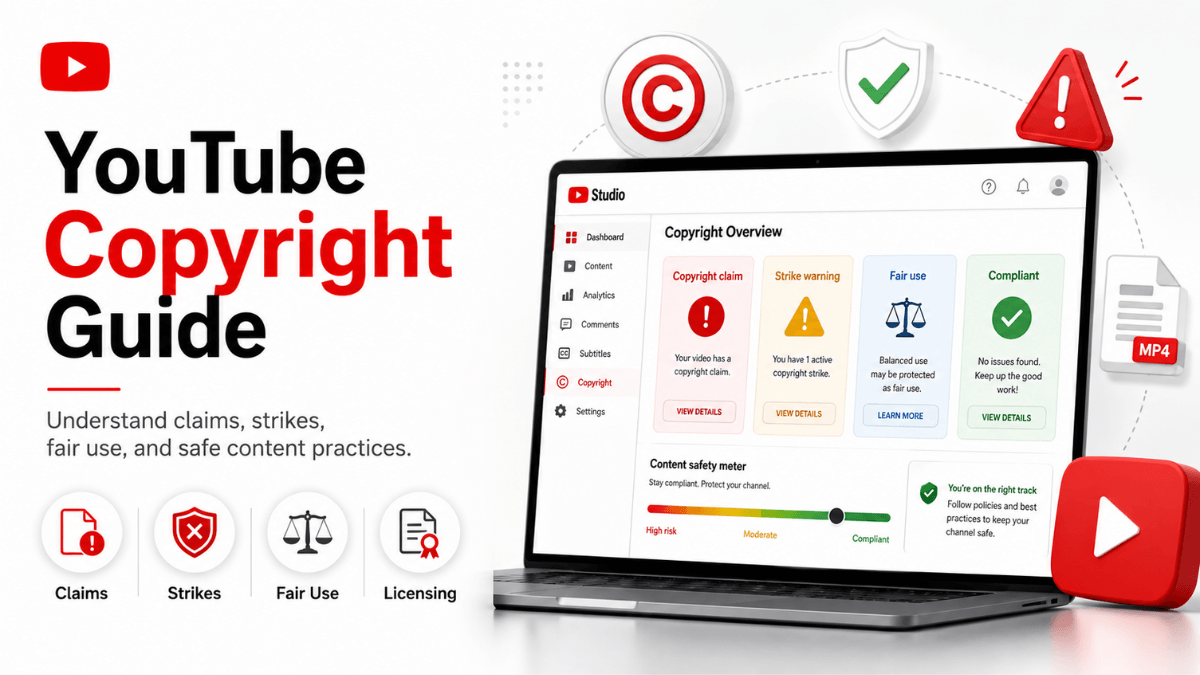
Direct answer: copyright protects expression rather than ideas: the song, the footage, the text, the image, not the topic, the title or the style. On YouTube there are two entirely different systems that people routinely confuse. A Content ID claim is an automated action decided by the rights holder and carries no penalty against your channel. A copyright strike is a legal action following a removal request and does carry a real penalty. Fair use, meanwhile, is an exception in United States law decided by courts rather than by YouTube, and it does not automatically apply to a channel operating from Saudi Arabia or the Gulf.
- Copyright protects expression rather than ideas, and there is no "allowed number of seconds".
- A Content ID claim is not a strike: no channel penalty, only an effect on revenue or availability.
- A copyright strike is a real penalty, and three active strikes means channel termination.
- Fair use is US law decided by courts, not a setting inside YouTube.
- Crediting the source or writing "I do not own the rights" grants no licence at all.
What copyright actually covers
The official page puts it simply: "think of copyright like the right to copy". An original work, a YouTube video included, generally belongs to its creator from the moment it exists, and the owner decides who may use and distribute it. To be eligible for protection, a work has to be creative and fixed in a physical medium, which is why abstract ideas, facts and processes are not protected.
That explains a frequent confusion: explaining another channel's idea in your own words is not a copyright problem, while re-uploading 40 seconds of their footage may well be, even if you name the channel on screen. YouTube also notes that appearing in a video does not make you its copyright owner; that is a privacy question with its own complaint process.
What you can use: licence types
YouTube names three comparatively safe ways to use someone else's work: a copyright exception applies (a determination for courts, not for you), you use the work under the terms of a Creative Commons licence, or you source music from the Audio Library or Creator Music.
At upload level, every video carries a licence: the standard YouTube licence, or the Creative Commons Attribution (CC BY) licence, which lets others reuse your work provided they credit you. If you are the one using CC BY material, the attribution is on you. YouTube also notes that a video with a Content ID claim on it cannot be marked with the Creative Commons licence. Music is the single biggest source of claims and has a page of its own: music and copyright on YouTube.
Claim vs strike: the definition table
YouTube states that a copyright claim refers either to a removal request or to a Content ID claim, two different ways of asserting ownership. The difference is the difference between a problem on one video and a problem for the whole channel:
| Aspect | Content ID claim | Copyright strike |
|---|---|---|
| Where it comes from | An automated matching system comparing your upload against files supplied by rights holders | A legal removal request submitted by a rights holder and reviewed |
| Effect on the video | Depends on the owner's settings: block, monetize for them, or track the statistics; the effect can differ by country | The video is removed from YouTube |
| Effect on the channel | No strike by default | A strike on the channel; three active strikes in 90 days puts the account at risk of termination |
| How long it lasts | Until it is resolved or the claimed content is removed from the video | Expires after 90 days if Copyright School is completed, or ends through a retraction or a valid counter notification |
| Special case | Any Short over one minute with an active claim is blocked globally | A video can carry only one copyright strike at a time |
What to do when one of them actually lands is a separate page, because each route has its own deadlines and forms: a copyright claim or strike on your video. How the matching system itself works, and what it does to revenue, is the subject of the next section.
How Content ID works
Content ID produces most claims, and understanding the mechanism removes a great deal of unnecessary panic: it is automated matching, not an accusation.
What Content ID actually is
According to YouTube's "How Content ID works" page, some copyright owners use Content ID, YouTube's automated content identification system, to identify and manage their copyright-protected content on the platform. The mechanism is simple: the owner deposits a reference file (an audio recording, a video, or both), and the system compares every new upload against those references.
The part that matters for you as a creator is that the scan does not wait for anyone to report your video. YouTube's "Copyright tips" page puts it plainly: videos uploaded to YouTube are scanned against a database of audio and visual content submitted by copyright owners. That is why some claims arrive within minutes of publishing, before anyone has watched the video.
One vocabulary point saves a lot of confusion. YouTube's "What is a copyright claim?" page explains that the phrase "copyright claim" covers two different things: a copyright removal request (a legal takedown that results in a strike on your channel) and a Content ID claim (a tool YouTube built, which does not). This page is only about the second kind. The full picture of how the two differ, and the other rights-holder tools, lives in the YouTube copyright guide.
How matching works, step by step
- Reference deposit: an approved rights holder uploads reference files and sets a policy for each one (block, monetize or track), optionally with different policies per country.
- Scan at upload: your video is compared with the database automatically, whether it is public or unlisted.
- Match: if a segment of your video (even a short piece of audio) matches a reference, a Content ID claim is created on the video and YouTube emails you.
- Policy applied: the owner's pre-set outcome takes effect and appears in YouTube Studio under the Restrictions column.
The official page adds that YouTube monitors Content ID use and disputes on an ongoing basis, and that copyright owners who repeatedly make erroneous claims can have their access disabled and their partnership terminated. In practice that does not mean every claim is correct, but it does mean the system is not unsupervised.
The three policies and their effects
The three policies and what they do to your video
The table summarises the outcomes as YouTube's "How Content ID works" and "Learn about Content ID claims" pages describe them on 19 August 2026:
| Owner's policy | What viewers see | What it means for you | Official note |
|---|---|---|---|
| Block | The video cannot be viewed, worldwide or in specific countries | Blocked in those regions; no strike on the channel | Blocks can be geography-specific: the same video may be blocked in one country and viewable in another |
| Monetize | The video is viewable with ads | Ad revenue goes to the rights holder, sometimes shared with the uploader | "The most common policy applied to music claims" |
| Track | The video is viewable as normal | The rights holder sees viewership statistics only | The lightest outcome for your channel |
YouTube also states that a tracked or monetized video stays viewable with the active claim on it, and that copyright owners "usually" choose to track or monetize rather than block. One video can carry claims from different owners for different segments, and even several claims on the same segment when rights differ by country.
The Shorts rule: a claim means a block
This is where Shorts differ sharply from long-form video. According to "Learn about Content ID claims", since 15 October 2024 all new vertical videos between one and three minutes are categorised as Shorts, and any Short longer than one minute with an active Content ID claim is blocked "regardless of the policy", even if the owner's policy is Monetize. The "Understand three-minute YouTube Shorts" page states it even more broadly: any Short over one minute with an active copyright claim of any type, including manual claims, is blocked globally, is not playable or recommended, and is not eligible for monetization, but "there are no penalties to your channel".
The Shorts monetization policies page adds the financial consequence: Shorts over one minute that contain claimed content are blocked and not eligible for monetization. If a claim lands on a Short, you get a notification; you can remove the claimed content or dispute the claim if you believe it was made in error, and once the claim is resolved the Short becomes viewable again. Choosing music that is licensed for Shorts and long-form uploads is covered in the YouTube music copyright guide.
What happens to revenue
What happens to revenue during a claim and a dispute
According to YouTube's "Monetization during Content ID disputes" page, a video can keep earning during a dispute if both the creator and the claimant want to monetize it. The revenue is held separately and, once the dispute is resolved, paid "to the appropriate party". Timing decides from which day the hold starts:
- Dispute within 5 days of the claim date: ads continue to run and all revenue the video earns is held, starting from the first day of the claim.
- Dispute after 5 days: revenue is held from the date the dispute is filed, not from the claim date.
- Do nothing: after 5 days from the claim date, any held revenue is released to the claimant.
- The same five-day rule applies to an appeal filed after a rejected dispute.
A practical note from the same page: while a dispute or appeal is open, revenue data for that video does not show in YouTube Analytics. If the claim is released, the data is added later, usually between the 10th and 20th of the following month or the month after that. You can also turn monetization off for the video during the dispute from the Videos page in Studio.
Who qualifies for Content ID
According to the "Qualify for Content ID" page, eligibility is based on several criteria, including whether the owner's content can be claimed through Content ID and the owner's "demonstrated need". Copyright owners have to give evidence of the content for which they control exclusive rights, because the system will match their reference files "against every upload to YouTube". The "How Content ID works" page adds that approved owners must own exclusive rights to a substantial body of original material that is frequently uploaded to YouTube.
The official page lists common examples of material that is usually not exclusive to an individual: mashups, "best of" compilations and remixes of other people's work; video gameplay, software visuals and trailers; unlicensed music and video, or music and video licensed without exclusivity; and recordings of performances such as concerts, events and speeches. Approved owners sign an agreement stating that only exclusively owned content can be used as a reference, and must specify the countries where they hold the rights if not worldwide.
In practice: if you are an independent creator who wants protection against re-uploads of your videos, the tools YouTube points you to on the same page are the copyright complaint webform and the Copyright Match Tool, not Content ID. Those tools are covered on the pillar page.
Manual claims: the protections built in for you
According to the official page, alongside automatic matching there is a "Manual Claiming tool" for copyright owners who demonstrate a need for it and have advanced knowledge of Content ID; it lets them claim videos the automatic scan did not match. The rules on it work in your favour: manual claims must have accurate timestamps so you know exactly what content is being claimed, the tool cannot be used for any other purpose, and owners who repeatedly select inaccurate timestamps can lose the tool or have their partnership terminated. If you believe the timestamps on a manual claim are wrong, YouTube points you to its Creator Support team.
Rights holder tools: who uses what
YouTube publishes three tiers of copyright management tools, and knowing them explains why two creators can have completely different experiences:
- The removal request webform: open to any rights holder, the legal route that produces a strike when a request is valid. YouTube also offers an option to prevent re-uploads of a removed video.
- Copyright Match Tool: uses the same matching technology as Content ID but is simpler to manage, and finds full re-uploads of your videos on other channels. It is available to channels that have filed a valid removal request or the relevant form.
- Content ID: described by YouTube as designed for owners with the most complex copyright management needs, such as record labels and movie studios, requiring ongoing management and advanced copyright knowledge.
The practical takeaway for an ordinary creator: you are usually on the receiving end of these tools, and your defence for original work starts with the webform, then the Match Tool if you qualify.
Fair use: United States law
This is the most misunderstood point in the whole subject, because the phrase gets used as though it were a setting in YouTube when it is a legal defence.
What YouTube's own page says
YouTube's "Fair use on YouTube" page opens by naming the jurisdiction: in US copyright law, fair use allows someone to use copyrighted content under certain conditions without needing permission from the copyright owner, and common examples can include works of commentary, criticism, research, teaching or news reporting.
The next line is the one most creators skip: courts decide fair use cases according to the facts of each unique case, and YouTube adds that you will "probably want to get legal advice from an expert before uploading videos that use copyrighted content". Fair use is a position you may have to defend, not a status your channel holds. This page explains what the official sources say; it is not legal advice, and it will not tell you that a particular video is fair use.
The wider framework, from public domain and derivative works to the tools rights holders use, sits in the YouTube copyright guide.
The four factors
The four factors, as YouTube lists them
According to the official page, a US judge considers how four factors apply to each unique case. The table restates what the page says as read on 19 August 2026:
| Factor | What YouTube's page states |
|---|---|
| Purpose and character of the use | Nonprofit education uses are "more likely to be considered fair use" than commercial uses, and adding new expression or meaning is more likely than merely copying the original. |
| Nature of the copyrighted work | Using material from primarily factual works is more likely to be considered fair use than using purely fictional works. |
| Amount and substantiality of the portion used | Borrowing small bits is more likely than borrowing large portions, but if what is borrowed is the "heart" of the work, even a small sample may not be fair use. |
| Effect of the use upon the potential market | Uses that harm the owner's ability to profit from the original are less likely to be fair, though courts have sometimes made an exception for parodies under this factor. |
Note the language YouTube uses: "more likely" and "less likely", never allowed or forbidden. There is no safe number of seconds and no safe percentage in any official page, so any such figure circulating in videos or forum posts is an unconfirmed claim rather than a rule.
What does not protect you
The fair use page has a section titled "Am I protected by fair use if I...", and the "Common copyright myths" page continues the list. These are the points as they are written:
- Giving credit: transformativeness is usually key in the fair use analysis, and crediting the owner will not by itself turn a non-transformative copy into fair use. Phrases like "all rights go to the author" and "I do not own" do not mean you have permission.
- Adding a disclaimer: "There aren't any magic words to automatically apply fair use", and including "no infringement intended" will not automatically protect you from a claim.
- Calling the use entertainment or non-profit: courts review the purpose carefully; declaring an upload to be "for entertainment purposes only" is unlikely to tip the scales, and non-profit uses are favoured in the analysis but are not an automatic defence.
- Adding your own material on top: even then the use may not be fair, and if your creation does not add new expression, meaning or message, "it probably isn't fair use".
- Using only a few seconds: the myths page states that any amount of copyright-protected content used without permission, even a few seconds, may result in copyright issues. The fair use page adds that a claim can stop you monetizing a video "even if you only use a few seconds, such as short uses of popular songs".
- Content you bought: purchasing a song or a DVD does not give you the right to upload or distribute it on YouTube.
- Other channels do it: similar content being on YouTube does not mean you have the rights; other creators may be licensed, or rights may sit with different owners.
- Parodies, covers and translations: the myths page states that using someone else's content to create something new, like a parody, cover song or translation, "usually still requires the copyright owner's permission", although some YouTube features, such as creating Shorts from remixable content, come with a corresponding licence.
Outside the United States
Outside the United States
Jurisdiction-specific legal information: YouTube's page states that rules about copyright exceptions are often similar around the world but can differ, and that different countries and regions may have different rules about when copyrighted content can be used without permission. The example the page gives is the EU, where the use must fit specific categories such as quotation, criticism, review, caricature, parody and pastiche; other countries and regions have a concept called fair dealing that may work differently.
For creators outside the US, including Saudi Arabia and the wider Gulf, the practical consequence is that the American doctrine is not a global rule and does not automatically describe your legal position. If your use depends on a copyright exception, the reference point is the copyright law of your own country and a qualified lawyer there. YouTube also states that it considers local rules when reviewing copyright removal requests, and points to its Copyright Transparency Report for detail on how those requests are processed.
Options that genuinely reduce risk
YouTube's "Copyright on YouTube" page lists the options for safely using copyrighted content, and follows them with a sentence that should never be dropped: none of those options guarantee avoiding copyright issues on YouTube, such as a copyright strike or a Content ID claim, and if you are unsure you may want to get legal advice before you upload. The options as listed are:
- Using content in a way that qualifies as a copyright exception, such as fair use, fair dealing or public domain.
- Getting permission from the owner. The licence types page notes that YouTube cannot grant you rights to someone else's content and cannot help you find the parties who can.
- Using content according to the terms of a Creative Commons licence, with the attribution the licence requires.
- For music, sourcing from the YouTube Audio Library or Creator Music.
In practice the clearest paths are the ones you control: your own footage, music whose licence you can produce on request, or cutting the protected segment. How the Audio Library, Creator Music and third-party libraries differ is covered in the YouTube music copyright guide.
Myths that cost channels
- "I credited the owner, so I'm fine": YouTube states plainly that giving credit does not grant you the rights.
- "I bought the song": buying a copy does not give you the right to upload or distribute it.
- "I put a disclaimer in the description": lines like "no copyright infringement intended" or "for entertainment purposes only" change nothing in the legal assessment.
- "It's only 10 seconds": there is no official duration below which use is automatically allowed.
- "My channel isn't monetized": non-commercial use is one factor a court may weigh, not an automatic defence.
Community Guidelines strikes are a different system
These two get mixed up constantly. Community Guidelines strikes concern content policy, not ownership. YouTube states that a first violation is typically a warning that can expire after 90 days through optional policy training, that a first strike carries a one-week posting restriction and a second a two-week one, and that three strikes in the same 90-day period may result in permanent removal of the channel. A separate counter from copyright, with a similar ending, which is why both deserve the same seriousness.
One note on income: losing monetization under the content policies is not a copyright problem, and the two paths are entirely different. The distinction is in the monetization policies guide.
Prevention: the pre-upload checklist
- Ask who owns every element in the video: music, footage, fonts, effects, the thumbnail image.
- Take music from the Audio Library or a licensed source, and keep proof of the licence.
- If you use a CC BY work, write the required attribution into the description.
- Check the copyright tab in Studio right after upload, before going fully public where that's an option.
- Keep original files and any permission correspondence: that paperwork is your position in a dispute.
Practical summary
- Separate the claim (an event on a video) from the strike (an event on a channel); the right response is entirely different.
- Don't rely on credit, disclaimers or clip length. None of them is a licence.
- Treat music as the highest-risk element in any video and clear it before editing, not after.
- If a notice arrives, read what type it is first, then follow the page written for that case; the deadlines are short and improvising makes it worse.
- This page is part of the YouTube Resource Hub, which routes on to the algorithm, growth, content and monetization guides.
Official sources
- Copyright on YouTube: the definition, the creative and fixed requirement, and the safer ways to use content (read 19 August 2026).
- What is a copyright claim?: a claim means either a removal request or a Content ID claim, and how they differ (read 19 August 2026).
- Understand copyright strikes: 90-day expiry with Copyright School, and three strikes in 90 days (read 19 August 2026).
- Common copyright myths: credit, purchases and disclaimers grant no rights, and only courts decide exceptions (read 19 August 2026).
- About YouTube's copyright management tools: the webform, Copyright Match Tool and Content ID, and who each is for (read 19 August 2026).
- License types on YouTube: standard licence, CC BY and attribution (read 19 August 2026).
- Community Guidelines strike basics: the warning, posting restrictions and three strikes in 90 days (read 19 August 2026).
- Fair use on YouTube: fair use as US law, courts deciding case by case, and fair dealing elsewhere (read 19 August 2026).
- How Content ID works - YouTube Help: scanning mechanism, the three policies, exclusive-rights requirement (read 19 August 2026).
- Learn about Content ID claims - YouTube Help: Shorts rule, "most common" policy for music, response options, manual claims (read 19 August 2026).
- Qualify for Content ID - YouTube Help: eligibility criteria, non-exclusive examples, agreement (read 19 August 2026).
- Monetization during Content ID disputes - YouTube Help: five-day rule, revenue hold, Analytics data (read 19 August 2026).
- YouTube Shorts monetization policies - YouTube Help: blocked Shorts are not eligible for monetization (read 19 August 2026).
- Understand three-minute YouTube Shorts - YouTube Help: global block for Shorts over one minute with any active claim, no channel penalties (read 19 August 2026).