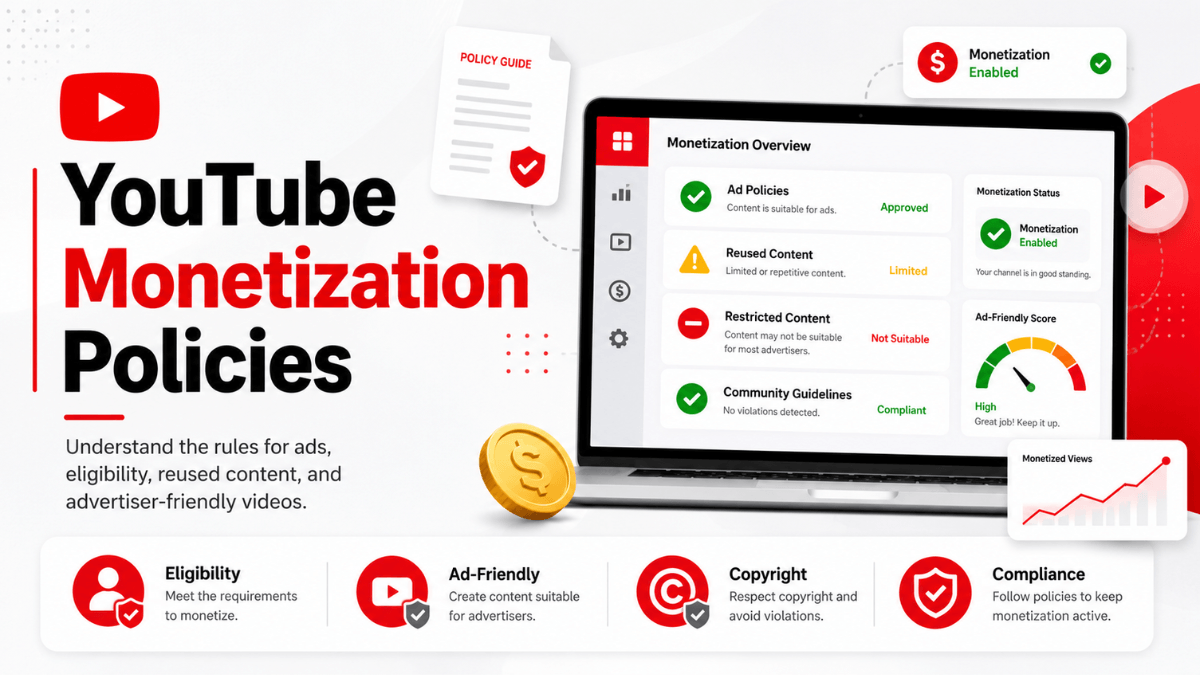
Direct answer: YouTube's monetization policies decide two separate things: whether your channel may earn at all, and how much each individual video earns. The channel is measured against the YouTube channel monetization policies (original and authentic content, Community Guidelines, Terms of Service, copyright, AdSense program policies), while each video is measured against the advertiser-friendly content guidelines, which place it in one of three states: it can earn ad revenue, it gets limited ad earnings (the yellow icon), or it gets no ad earnings. As of 19 August 2026, automated decisions can be sent for human review, and a policy specialist's decision after that review is final.
- A yellow icon is not a punishment on your channel: it is one video assessed against the advertiser guidelines, and you can ask for human review.
- On 15 July 2025 YouTube renamed its "repetitious content" policy to "inauthentic content", saying such content was never eligible for monetization and that the reused content policy is unchanged.
- Disclosing realistic AI-generated content is required, and YouTube states that the disclosure itself does not limit a video's audience or affect its eligibility to earn.
- Made-for-kids content still earns, but only from contextual ads, because personalized ads are prohibited on it.
- This page does not cover the thresholds for joining the Partner Program; those live on the requirements page.
Two levels: channel policies and video policies
Most of the panic around demonetization comes from mixing the two levels. The first applies to the channel: the channel monetization policies must be followed alongside the Community Guidelines, Terms of Service, copyright policies and AdSense program policies, plus the Shorts monetization policies if you monetize Shorts. The standard is that content should be your own creation, significantly changed if borrowed, and not mass-produced, generic, repetitive or manipulative. The page names what reviewers look at: main theme, most viewed videos, newest videos, the videos with the biggest share of watch time, metadata including titles, thumbnails and descriptions, and the About section, while noting other parts may be checked too.
The second level applies to a single video: is it suitable for advertisers? That is where the icons live, and where most "I lost monetization" cases sit while the channel itself is fine. Entry requirements are a separate subject, covered in the YouTube monetization requirements guide, with the mechanics of the program in our Partner Program explainer and the income map in the YouTube monetization guide.
The monetization icons and what to do about each
This table summarises YouTube's monetization icon guide as of 19 August 2026. The icons sit in Studio under Content, in the Monetization column, and you can filter by them.
| State | What it means | What to do |
|---|---|---|
| Checking | Systems are checking the video for ad suitability, and no ads run while they do | Wait: the check "usually takes less than 20 minutes and at most 1 hour", so upload private or unlisted and publish after it completes |
| On (green) | The video meets the advertiser-friendly guidelines and is eligible for most ads | Nothing, though revenue can be held temporarily over a copyright dispute or invalid traffic |
| Limited (yellow) | The video does not meet all the advertiser guidelines, brands can opt out, and it may earn less | Read the status: "Ad suitability" is an automated call you can send to human review, "Under review" means a specialist is looking, "Confirmed by review" is final |
| Ineligible (red) | Usually a copyright claim or a valid removal request; the video cannot be monetized | Deal with the claim itself rather than the icon |
| Exceptions | The video's audience is set as made for kids, so it is eligible for non-personalized ads only | Check that the setting genuinely matches your content |
| Sharing | A cover video claimed by a music publisher that shares revenue with creators | Revenue splits with the rights holders |
| Escrow | Revenue held separately during a Content ID dispute | See the dispute through; the revenue then goes to whoever is entitled |
| Off | You turned monetization off, or you have not accepted the Shorts Monetization Module in Studio | Check the video setting, or accept the module |
Why does green turn yellow after publishing? The systems keep scanning. YouTube says the status generally stabilises within 24 hours, can still change afterwards depending on viewer interaction, and does not change once a specialist has decided; since 10 March 2025 an additional human review has been part of the process and a decision may take up to 24 hours. One detail worth remembering: invalid traffic never causes a yellow icon, which comes only from the advertiser-friendly guidelines.
Advertiser-friendly content guidelines
This is the document your videos are measured against one by one, and it covers "all portions of your content (video, Short, or live stream, thumbnail, title, description, and tags)". YouTube lists 14 topics that are not advertiser-friendly: inappropriate language, violence, adult content, shocking content, harmful acts and unreliable content, hateful and derogatory content, recreational drugs and drug-related content, firearms-related content, controversial issues, sensitive events, enabling dishonest behavior, inappropriate content for kids and families, incendiary and demeaning content, and tobacco-related content.
Each topic is split into the same three tiers: what can earn ad revenue, what receives limited ad earnings, and what receives none. Context is decisive in YouTube's own wording: artistic, journalistic, educational and documentary treatments can stay suitable for advertising even with sensitive elements. At upload you answer the self-certification questionnaire, and answering accurately reduces later status changes. Topic choice is a commercial decision as much as a creative one, which is part of comparing niches in the YouTube content ideas guide.
Inauthentic and reused content
This is the section that stops whole channels rather than single videos. The banner dated 15 July 2025 says YouTube made "a minor update" to the repetitious content policy to clarify that it covers repetitive or mass-produced content, renamed it from "repetitious content" to "inauthentic content", noted that such content has always been ineligible for monetization, and confirmed no change to the reused content policy that reviews commentary, clips, compilations and reaction videos. Four sections on the page carry the detail today:
- Generic or repetitive content: videos must not look template-made or feel interchangeable. Allowed: the same intro and outro with materially different content, or a series where each episode has its own storyline or concept.
- Reused content: judged across the whole channel. Allowed: clips inside a critical review, a scene you rewrote and revoiced, reactions where you comment, edits that add a storyline. Not allowed: compilations with little narrative, material copied without substantive modification, or readings of text you did not write. YouTube notes this policy is separate from copyright, so you can be clear of claims and still breach it.
- Unsatisfying or off-putting content: content leaning on emotionally manipulative formulas or built to shock without a coherent narrative. Automated tools and AI are explicitly allowed where the result still carries your creative vision and delivers value.
- AI personas related to sensitive topics: channels using AI-generated personas that present themselves as human experts giving health, legal, financial or political advice are not allowed to monetize.
AI content: disclosure and the limits on earning
The "Disclosing use of GenAI content" page requires disclosure when AI meaningfully alters or generates photorealistic content: making a real person appear to say or do something they did not, altering footage of a real event or place, or generating a realistic scene that never happened. You disclose through the "AI use" setting at upload, and viewers see a label in the player or the expanded description.
What needs no disclosure: non-realistic content, minor edits such as beauty filters and colour correction, production assistance such as outlines, scripts, titles or thumbnails, captions, audio repair, and cloning your own voice for dubs.
Read this line literally: "Disclosing AI content won't limit a video's audience or impact its eligibility to earn money." Disclosure is not what costs you money; the policies above are, through mass production, synthetic experts on sensitive topics and deceptive content. YouTube may also label automatically content made with its own AI tools, content carrying C2PA metadata, or content its systems detect, and in most cases you can correct the survey. Consistently choosing not to disclose can lead to manual labelling or penalties up to content removal or suspension from the Partner Program.
Made-for-kids content
Telling YouTube whether your content is made for kids is compulsory wherever you live, under YouTube's agreement with the US Federal Trade Commission and to support COPPA compliance; the page says plainly that it is not legal advice. Three consequences follow for monetization:
- Personalized ads and remarketing are prohibited on this content and on supervised accounts. What remains is contextual advertising, based on the content being viewed, the current search and general location.
- Whole advertising categories are barred on it, among them food and drink, beauty and weight loss, dating, and political and religious ads.
- The quality principles for kids and family content feed into monetization: a video that breaches them may see limited or no ad earnings, and a channel with a strong focus on low-quality kids content may be suspended from the program. The principles enforced today: heavily promotional, encouraging negative behaviours, deceptively educational, hard to follow, sensational or misleading, and strange use of children's characters.
The channel activity rule
From 1 February 2027 a channel counts as active if it has 1,000 qualified watch hours in the past 365 days, or 1 million qualified Shorts views in the last 90 days, or uploads 2 long-form videos or 5 Shorts every 90 days. Channels that drop below get an extended 90-day window to meet one of the first two before leaving the program. The same page notes that updated terms must be accepted in Studio by 31 January 2027, otherwise earning from the associated features stops on 1 February 2027 until they are accepted.
Community Guidelines strikes and monetization
Content violating the Community Guidelines is not eligible for monetization and is removed, and for monetizing creators the guidelines apply to the channel as a whole. The strike basics page sets out the sequence: a first violation is typically a warning with no penalty, expiring after 90 days if you take the optional policy training; a first strike blocks uploading and streaming for 1 week; a second within the same 90 days blocks it for 2 weeks; 3 strikes in the same 90-day period may mean permanent removal. Each strike lasts 90 days, and deleting the content does not remove it.
If you lose monetization: your options
- A yellow icon on a video: request human review from Studio if you believe the automated assessment is wrong. If the status already reads "Confirmed by review", the decision is final.
- A red icon from copyright: an entirely different route, through disputing or appealing the claim itself, as set out in the YouTube copyright guide.
- Channel-level suspension: the listed actions are withholding, adjusting, charging back or offsetting earnings with payment delays of up to 90 days while YouTube investigates, limiting ad earnings, suspending participation in the program, and in exceptional cases terminating the channel, with written notice and the options available.
- Do not promise yourself an outcome: no official page says a review or appeal restores monetization. The official wording is that a specialist "can keep or change" the status.
- Creator integrity: artificially inflating engagement (views, subscribers, likes, watch time, ad impressions) can mean removal from the program or channel termination. Buying engagement falls squarely here and counts toward nothing.
Frequently asked questions
What does the yellow dollar sign actually mean?
It means the video does not meet all of the advertiser-friendly content guidelines, so advertisers can opt out and the video may earn less. It is an assessment of one video, not a penalty on the channel, and it is never caused by invalid traffic.
Is AI-generated content banned from monetization?
Not as a category. What is barred is mass production from generic templates with no original perspective, AI personas advising on sensitive topics, and deceptive content. Disclosing AI use does not affect a video's eligibility to earn, in YouTube's own words.
Can monetization be restored after it is switched off?
YouTube explains the review and reapplication routes and tells you what options you have, but promises no outcome. The useful work is fixing the cause: originality, repeated violations, or artificial engagement.
Practical summary
- Separate the levels: a video problem is solved by review, a channel problem is solved by changing how you produce.
- Check the Monetization column in Studio regularly and read the status description, not just the colour.
- Make every video materially different from the last, and add visible value to anything you borrow.
- Disclose realistic AI use without fearing for your revenue, and stay away from mass production.
- Set the made-for-kids flag honestly, and deal with warnings the day they arrive.
- For the whole growth and monetization picture, start from the YouTube Resource Hub.
Official sources
- YouTube channel monetization policies: the 15 July 2025 banner, the generic, reused, off-putting and AI persona sections, and the enforcement actions (read 19 August 2026).
- Advertiser-friendly content guidelines: the 14 topics, the three earning states and the self-certification questionnaire (read 19 August 2026).
- Monetization icon guide for YouTube Studio: what each icon means, the status descriptions and requesting human review (read 19 August 2026).
- Disclosing use of GenAI content: when disclosure is required, its neutral effect on eligibility, and the risks of not disclosing (read 19 August 2026).
- How ads work for supervised accounts and "made for kids" content: no personalized ads and the barred ad categories (read 19 August 2026).
- Determining if your content is "made for kids": the criteria and their FTC and COPPA basis (read 19 August 2026).
- Changes to the YouTube Partner Program: the activity rule from 1 February 2027, the 90-day window and accepting terms (read 19 August 2026).
- Community Guidelines strike basics on YouTube: warnings, strikes, their durations and effects (read 19 August 2026).