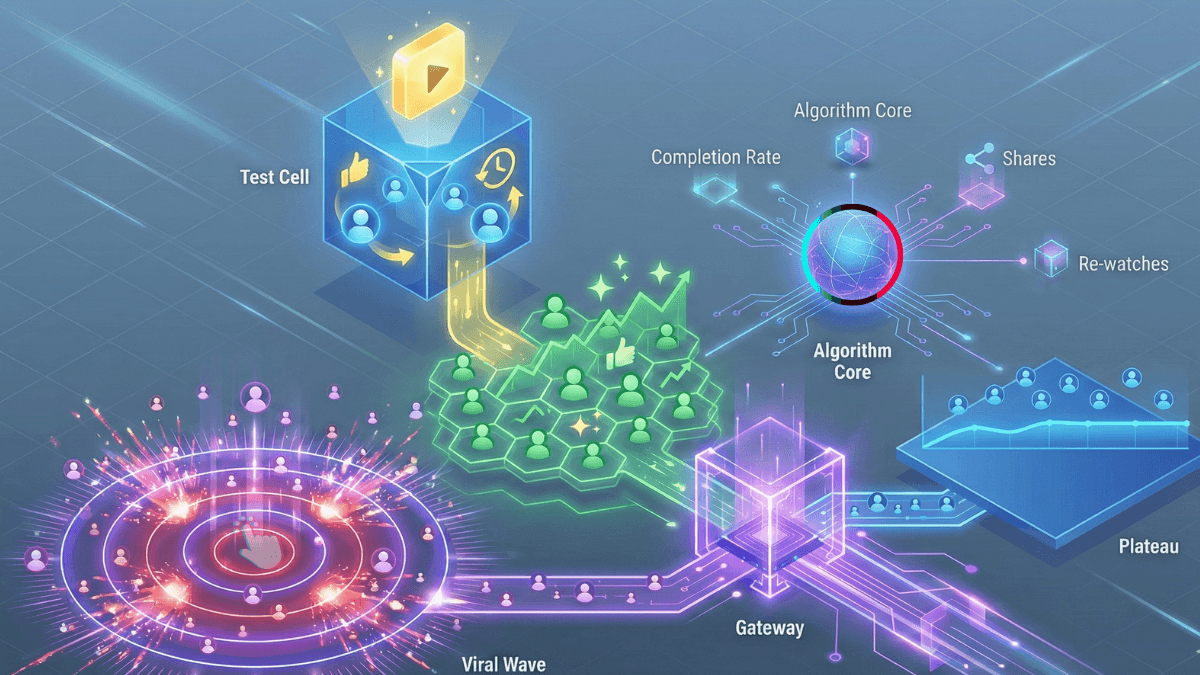
TikTok doesn't show your video to millions at once — content passes through four sequential test waves. Each wave is an exam: if the video passes, it advances to the next; if it fails, it stops there. A video starts with 100 to 300 local viewers and can end with millions across borders — but only if it clears each wave with strong signals. The key is convincing strangers in the test batch, not just your existing followers.
| Wave | Audience size | Time window | Advancement threshold |
|---|---|---|---|
| First | 100 to 300 viewers | First 30 to 60 minutes | 60%+ retention past 3 seconds + 20–25% overall completion |
| Second | 1,000 to 5,000 viewers | 2 to 6 hours | Sustained completion + combined engagement rate 8–10% |
| Third | 10,000 to 50,000 viewers | 12 to 24 hours | Official FYP entry as a candidate for viral spread |
| Fourth | 100,000 to 1M+ | 48 hours to weeks | Full viral phase crossing geographical borders |
Key Takeaways
- Passing wave one on follower engagement alone isn't enough — the video must convince strangers who have never heard of you.
- Stalling at 200 views = wave one failure. Stalling at 1,000–1,500 = wave one passed, wave two failed.
- Distribution starts locally (your city and country) then expands regionally then globally — your language is a feature, not a limitation.
- An old video can be re-entered into wave one as brand new from a single unexpected interaction (comment, Duet, or external share).
- Length doesn't determine distribution — completion rate does. A 15-second video with 80% completion outperforms a 60-second video with 10% completion.
How Do TikTok's Four Distribution Waves Work in Numbers?
If you're a TikTok creator trying to understand how your video reaches a wider audience, this guide explains the wave distribution system that determines every video's fate. According to TikTok's official recommendation system documentation, every video passes through a series of sequential test batches — each one dependent on the success of the previous one. For the complete picture of how the TikTok algorithm works, see our full guide.
What sets TikTok apart from every other platform: distribution starts from zero regardless of account size. 90% to 95% of the initial test batch are strangers who have never seen you before — not your followers.
| Wave | Audience size | Time window | Algorithm's role |
|---|---|---|---|
| First | 100 to 300 viewers | First 30 to 60 minutes | Initial local test to measure hook impact in the opening seconds |
| Second | 1,000 to 5,000 viewers | 2 to 6 hours | Expanding the sample to people who resemble those who engaged in wave one |
| Third | 10,000 to 50,000 viewers | 12 to 24 hours | Official entry to the FYP as a candidate for viral spread |
| Fourth | 100,000 to 1M+ | 48 hours to weeks | Full viral phase crossing geographical borders |
To understand the real timing expectations at each wave and what they mean in practice, see our article on how long a TikTok video takes to go viral.
What Are the Minimum Thresholds for Advancing Between Waves?
These figures are derived from tracking content performance — TikTok does not publicly disclose the precise thresholds for each wave. For the algorithm to push a video from one phase to the next, it must hit minimum performance benchmarks:
From wave one to wave two
- Retention rate after the first 3 seconds: 60%+
- Total completion rate: must exceed 20% to 25%
From wave two to wave three (opening the FYP)
- Completion rate remains a baseline requirement
- Combined engagement rate (like + comment + share + save): minimum 8% to 10% of total wave-two viewers
These numbers explain why a strong hook is non-negotiable — without it the video dies in wave one and the story ends there. For the full weights of each signal and how they drive wave advancement, see our article on TikTok algorithm signal priorities. For the techniques behind building a hook that clears the first-second threshold, see our TikTok hooks guide.
How Does a Real Video Move Through All Four Waves?
These are the real numbers from an 18-second technical video tracked precisely through each phase until it reached half a million views — many creators observe a similar pattern in their highest-performing content:
| Phase | Views | What happened |
|---|---|---|
| Hour one | 210 | 32% completion + 4 shares → green light for wave two |
| Hour four | 4,800 | 400 likes + 30 comments + 80 saves → algorithm reads: high reference-value content |
| After 24 hours | 65,000 | Comments turned into heated discussions → dwell time rose → wave three opened |
| After 48 hours | 540,000 | 95.2% of views coming from FYP → full wave four |
Notice the gap between hour four and hour 24: from 4,800 to 65,000 in one step — that is the algorithm's decision to open wave three. To understand what retention rate is considered good at each stage, see our article on what's a good TikTok retention rate.
Why Do Videos Stall After 1,000 Views Despite a Strong Start?
Many creators celebrate 1,000 views in the first hour then are shocked when the counter stops completely. Here is exactly what happens:
A comedy video quickly accumulated 1,200 views in the first two hours — it passed wave one successfully because loyal followers watched it to the end and engaged. But when the algorithm moved the video to wave two and showed it to 3,000 people who had never seen the creator before:
- Completion rate collapsed from 35% to 4%
- Immediate skip rate reached 85%
The algorithm recognised the video only appealed to the creator's inner circle and wasn't relevant to the general audience — so it pulled the video immediately. It stopped at 1,450 views despite the promising start.
The Core Lesson
Passing wave one on follower strength alone isn't enough — the video must convince strangers who have never heard of you. Your hook and pacing must work for someone seeing you for the very first time.
For the detailed causes of low TikTok views, see our article on why TikTok videos get no views. For how the algorithm tests your video technically, see our guide on how TikTok tests a video before distributing it.
How Does Geography Affect TikTok's Distribution Decision?
According to TikTok's Analytics Help Center, view sources by geography are trackable in TikTok Studio — which reveals the gradual expansion pattern from local to global:
- Wave one: always shown to people in your own city or country based on your phone's IP address and SIM card
- Wave two: if successful locally, pushed to neighbouring countries that share the same language
- Wave four: only reaches a global audience if the video is purely visual or musical, or if it achieved extraordinary completion rates locally and regionally first
This means your language is a feature, not a limitation — your content targets a massive audience of hundreds of millions of speakers before it even considers going global. To understand whether followers affect the geographic reach of your distribution, see our article on do followers affect TikTok reach.
What Wakes Up an Old TikTok Video and Sends It Back Into Distribution?
A video published six months ago that stopped at 2,000 views suddenly starts accumulating 10,000 views per day. What happened?
The mechanism is simple: a user found the video through search or profile browsing, and did one thing — wrote a comment, made a Duet, or shared the video outside the platform. That single interaction woke the algorithm and caused it to re-enter the old video into wave one as if it were brand new.
Many creators observe this revival pattern happening consistently with evergreen content — especially when the video becomes relevant to a seasonal trend or search spike that appeared after the original publish date. This proves that well-crafted content never truly dies — it simply waits for the right moment.
To understand this phenomenon in detail and how to build content that benefits from it, see our article on how long a TikTok video takes to go viral.
What Do Creators Ask About How TikTok Distributes Videos?
How does TikTok choose who sees a video?
TikTok distributes videos through 4 sequential waves. It starts with a small local sample of 100 to 300 people and measures completion rate and engagement. If it clears the minimum threshold (60%+ retention past 3 seconds + 20–25% overall completion), it advances to a sample of 1,000 to 5,000 people, and so on until it reaches millions in wave four. TikTok does not publicly disclose the precise thresholds for each wave.
Why does a TikTok video stop at 200 or 1,000 views?
Stalling at 200 views means wave one failed — completion rate was below 20% or the immediate skip rate exceeded 75%. Stalling at 1,000–1,500 views means wave one passed but wave two failed — the video worked for followers but failed to engage strangers who don't know you. The fix is usually the hook: the first 2–3 seconds must work for people who have never seen you before.
How long does TikTok's algorithm take to make a distribution decision?
The first decision happens within 30 to 60 minutes (wave one). The second decision comes between 2 and 6 hours (wave two). Official FYP entry happens between 12 and 24 hours. Full wave four can take anywhere from 48 hours to several weeks. This is why you should never judge a video before 7 days have passed.
Does TikTok show videos to your followers first?
No — TikTok sends 90% to 95% of distribution directly to the For You Page (FYP), which is a new audience that has never seen you before. Only a tiny fraction goes to the Following feed. This is the opposite of Instagram Reels, which directs 60–80% of the first wave to your existing followers.
Do longer TikTok videos get better distribution than shorter ones?
Not automatically — length alone does not determine distribution; completion rate does. A 15-second video with 80% completion outperforms a 60-second video with 10% completion. That said, longer videos above 60 seconds that maintain a strong completion rate earn an additional advantage in total dwell time — which is a growing priority signal as TikTok pushes creators toward longer-form content.
Conclusion
The journey from publishing to the FYP is not luck — it is one exam after another. Understanding each wave's requirements transforms content decisions from guesswork into a measurable strategy. Design your hook for strangers, your pacing for completion, and your ending for a strong signal — and the algorithm will open the doors. TikTok does not publicly disclose the precise thresholds for each wave — but the patterns described here are consistently observed by many creators across different niches.
To understand how the algorithm tests each video technically at every wave, see our guide on how TikTok tests a video before distributing it. For the complete picture on FYP strategy, see our TikTok FYP strategy guide.