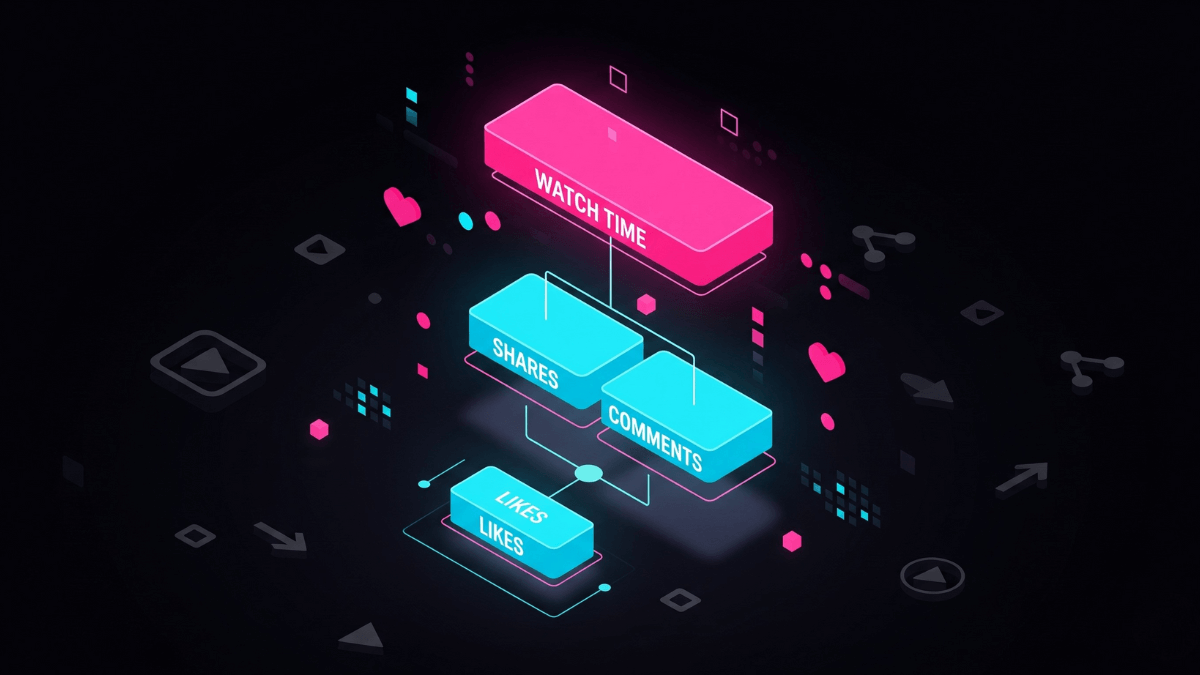
The TikTok algorithm signal ranking from strongest to weakest: completion rate and rewatches (strongest — officially documented) ← shares and saves (strong — signals deeper intent) ← comments (moderate) ← likes (weakest). TikTok does not publicly disclose specific numeric weights — this ranking is built from its official documentation and independent research consensus. The core principle: each signal tells the system something different, and content design starts with choosing which signal you're targeting.
| Signal | Rank | What It Tells the System | How to Design for It |
|---|---|---|---|
| Completion rate / rewatch | Strongest ① | "This content was worth the time" | Strong hook + escalating pace + loop-inducing ending |
| Shares (off-platform and DMs) | Very strong ② | "This content deserves to be seen by others" | Shared experience, surprise, entertainment, or useful information |
| Saves | Strong ③ | "This content has reference value I'll return to" | Lists, step-by-step guides, educational reference content |
| Comments | Moderate ④ | "This content provoked a reaction" | Open-ended question, debatable opinion, or visible gap |
| Likes | Weakest ⑤ | "This content was pleasant" | Don't design for it in isolation — it follows stronger signals naturally |
| Follows from video | Special ⑥ | "This creator deserves to be followed" | Content series or clear niche identity that makes the viewer want more |
| Quick exits / Not Interested | Negative ✗ | "This doesn't suit me" | Hook that filters the right audience from the first second |
Key Takeaways
- TikTok values signals that require genuine intent — finishing a video is harder than tapping a like, which is why the system assigns it more weight.
- The strongest signal determines the entire test batch outcome — one video with low completion stops distribution even if it receives many likes.
- Shares are the video's "ambassador" — each share triggers a new distribution cycle to a new audience pool.
- Saves signal reference value — the system knows that saved content is worth routing to people who need it.
- TikTok doesn't disclose numeric weights — any specific percentage (40%, 60%, 2x) is a research estimate, not official documentation.
Why Aren't All TikTok Signals Equal?
If you're a TikTok creator who's noticed that some videos spread with few likes while others stall despite getting many, the answer lies in signal ranking, not luck. Understanding how the TikTok algorithm works makes clear that the system doesn't count all interactions with the same weight — it ranks them based on what each one tells the system about genuine viewer interest.
Per TikTok's official documentation, the recommendation system assigns greater weight to "strong indicators of interest" — such as finishing a longer video from beginning to end — and lower weight to "weak indicators" — such as the viewer and creator being in the same country. The core logic: the more effort or intent a signal requires from the user, the more accurate the information it carries about their genuine interest.
The Logic of the Ranking — Why Completion Outweighs a Like
- Like: One tap — low effort, sometimes given without real engagement.
- Comment: Requires thought and typing — higher effort, reflects genuine reaction.
- Save: Requires the intent "I want to return to this" — signals perceived reference value.
- Share: Requires the intent "I want someone else to see this" — highest social cost.
- Completion: Requires full time investment — cannot be faked, reflects genuine interest.
Many creators consistently observe that their videos with the highest view counts weren't necessarily the ones with the most likes — they were the ones with the highest completion rates. This isn't coincidence.
Why Are Completion Rate and Rewatch the Strongest Signals?
Completion rate — the percentage of viewers who watch a video all the way through — is the one signal that's hardest to manufacture. A like can be given in one second, but finishing a 30-second video means the viewer actively chose to continue rather than scroll away.
Rewatches carry additional weight because they mean the viewer didn't just watch once — they chose to watch again. The system interprets this as "very high value" and sends a strong expansion signal to the next distribution wave.
What Determines Completion Rate?
Completion Rate Factors — From Highest Impact
- The hook in the first two seconds: If the hook doesn't stop the scroll, there's no completion to measure. This is the single most critical moment.
- Pacing throughout the video: Any "dead moment" where the viewer loses interest drops completion. Every second must deliver value.
- Appropriate video length: A video longer than its content collapses its own completion rate. The rule: end the video at the point where drop-off would begin.
- An ending that prompts a rewatch: "Circular" endings, unexpected reveals, or incomplete loops encourage viewers to watch again.
To learn how to build a hook that stops the scroll and raises completion rate, see our guide on TikTok hooks: types and highest-performing formats.
Why Is Sharing Off-Platform a Powerful Expansion Signal?
A share — sending a video via DM or publishing it outside TikTok — is the signal most predictive of large-scale spread. The reason: every share triggers a new distribution cycle.
When a user shares your video with someone who doesn't follow you, the video reaches a completely new audience outside the original test batch. If that new audience engages positively, the system sees that as additional proof of the video's quality and expands distribution further. Videos that reach millions of views in 48 hours typically start with a chain of successive shares — not a high like count.
What Content Gets Shared Most?
- Content describing a shared experience: "This is exactly me" — the viewer sends it to someone in the same situation.
- Content that surprises or astonishes: Surprise creates an impulse to share immediately.
- Entertainment that would make someone else happy: "This will make my friend laugh."
- Information someone else needs to know: "You'll benefit from this."
How Does Saving Differ From Sharing in the Algorithm's View?
Shares and saves are both strong signals — but they tell the system different things:
| Signal | What It Tells the System | Content Type That Generates It | Effect on Distribution |
|---|---|---|---|
| Share | "This deserves to be seen by others right now" | Entertainment, relatable, surprising | Immediate expansion to a new audience |
| Save | "I'll return to this later — it has reference value" | Educational, lists, guides, tips | Expansion to the niche-interested audience |
Educational and instructional content naturally generates higher save rates — because the viewer wants to return to apply it later. This is why educational content tends to reach a niche-interested audience specifically, which improves the quality of the test batch and produces better expansion signals downstream.
What Role Do Comments Play in the Distribution Decision?
Comments are a moderate signal — stronger than likes because they require actual effort, but weaker than saves and shares because the system doesn't know whether a comment is positive or negative.
What the system measures is the presence of a comment, not its content — a comment saying "this is great" and one saying "this is terrible" produce roughly the same quantitative signal from a distribution standpoint. This is why controversial content (which provokes opposing reactions) can sometimes spread quickly — comments accumulate regardless of their direction.
How to Target Comments as a Signal
- Ask an open-ended question at the end of the video, not the beginning.
- Leave a visible gap that viewers want to fill — people comment to add what you missed.
- State a debatable opinion — not unnecessarily controversial, but something some viewers will disagree with.
Why Can't Likes Alone Drive TikTok Distribution?
Likes are the weakest positive signal — not because they're irrelevant, but because they're the lowest-effort action available to a viewer. A like can be given in one second during scrolling, and is sometimes given without actually watching the video.
TikTok's system accounts for this — which is why it treats a like as a mild interest signal rather than a strong indicator of content quality. A video with a hundred shares and a thousand likes will distribute significantly better than one with ten shares and ten thousand likes.
Don't Design for Likes in Isolation
Directly asking viewers to "hit like if you found this helpful" generates likes without completion and without shares — the weakest possible signal combination. Content that naturally produces completion and shares will receive likes without asking. The signal hierarchy works from the top down: fix completion first, then shares, and likes follow.
What Are Negative Signals and How Do They Stop Distribution?
Negative signals narrow or stop distribution — and they're outside the creator's control once they appear, which is why prevention matters more than recovery.
| Negative Signal | What It Tells the System | How to Prevent It |
|---|---|---|
| Quick exit in first 2 seconds | "The hook didn't stop the scroll" | Hook that immediately communicates value or triggers curiosity |
| Leaving mid-video | "The content didn't justify continuing" | Escalating pace — every segment must deliver something new |
| "Not Interested" tap | "This content doesn't suit me" | Hook that filters the right audience from the first second — keeping non-matches from even starting |
| Video reports | Signals a potential content or policy issue | Follow TikTok's Community Guidelines |
The most dangerous negative signal is the quick exit in the first two seconds — because it happens during the initial test batch and stops expansion before any wider audience ever sees the video. See our article on how TikTok tests your video for a full breakdown of how the test batch works.
How Do You Design Content That Targets the Right Signal?
Every video should target one primary signal — not attempt to optimize for all signals simultaneously. A video trying to be funny and educational and thought-provoking and entertaining all at once typically does none of them well.
Choose Your Signal — Then Design for It
| If You're Targeting | Ideal Format | Niche Example |
|---|---|---|
| Completion | Hook that builds curiosity → escalating pace → satisfying close | Story, progressive explanation, delayed reveal |
| Shares | Shared experience, surprise, or entertainment | Comedy, "this is exactly me," unexpected information |
| Saves | List, steps, reference tips | Educational, recipes, tools, how-to guides |
| Comments | Open question or debatable opinion at the end | Opinion piece, comparison, "what do you think about..." |
Rewatches are best generated by: information-dense videos, unexpected endings, or content where "I didn't notice everything the first time." To measure your video's actual signals and analyze drop-off points, see our guide on reading TikTok Analytics. If your signals are consistently weak, see our guide on causes of chronically low TikTok views. For how these signals compare between TikTok and Reels, see our comparison of TikTok vs Reels algorithm.
To understand how these signals interact with the complete distribution cycle they trigger, see our guide on how TikTok distributes videos.
What Do Creators Most Often Ask About TikTok Algorithm Signals?
What is the strongest signal in the TikTok algorithm?
Completion rate and rewatch are the strongest signals, per TikTok's official documentation which explicitly states that finishing a longer video from beginning to end receives greater weight than weaker indicators. TikTok does not publicly disclose specific numeric weights, but independent research consistently finds that completion carries roughly twice the weight of any other single signal.
Does getting likes increase TikTok reach?
Likes are recorded as a positive signal but they rank as the weakest engagement indicator in TikTok's system. The algorithm values signals that require genuine intent — a like is significantly lower-cost than saving or sharing. A video with fewer likes but more shares will consistently outperform one with many likes and few shares from a distribution standpoint.
Is saving a TikTok more important than liking it?
Yes — saves carry more weight than likes. A save signals reference value and deeper intent than a quick like. Educational content, lists, and how-to guides that generate high save rates consistently receive stronger distribution because the system routes them to audiences who are actively looking for that type of information in the For You Page (FYP) feed.
How do I design TikTok content that generates strong signals?
Start by choosing one primary target signal per video. For completion: strong hook in the first two seconds and escalating pace. For shares: content that describes a shared experience or surprises. For saves: lists or reference information. For comments: open-ended question or debatable opinion at the end. Each video should be designed around one signal clearly — not all of them at once.
Does follower count affect TikTok signal strength or distribution power?
No — per TikTok's official documentation, follower count and previous video performance history are not direct factors in the recommendation system. Test batch signals are the sole determinant of expansion. An account with zero followers gets a genuine FYP opportunity if its video signals are strong enough.
Conclusion
TikTok's signal ranking follows one logic: the more effort or genuine intent a signal requires from the viewer, the more accurate the information it carries about their real interest — and the higher the weight it receives. Completion rate leads because it cannot be manufactured; the viewer actively chooses to continue or scroll away.
Per TikTok's official creator tips, understanding what generates engagement in your audience is what guides what to create next. Many creators who track their analytics consistently find that videos designed around one primary signal outperform videos that try to optimize for all signals simultaneously. The practical application: decide which signal you're targeting in each video before production, then design every element — the hook, the pace, the ending — to serve that specific signal. For the complete picture of how the distribution cycle that these signals trigger actually works, see the TikTok algorithm guide.