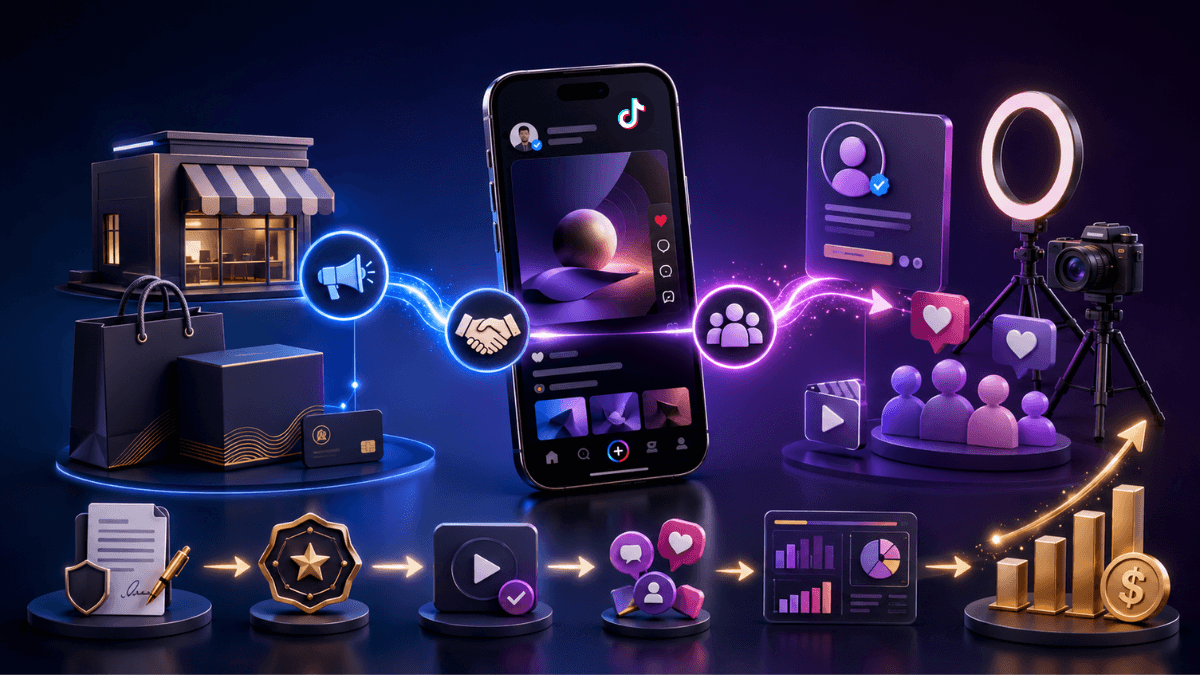
Direct answer: brands do not buy follower counts. They buy a describable audience and provable performance, and both come out of your analytics rather than your bio. And the price of a deal is not read off a table. It is built from the deal's parts: how many deliverables, whether the brand gets to run your video as an ad, how long you are locked out of competitors, how many revision rounds, and how fast you have to turn it around.
Two obligations come before any number. TikTok requires commercial content to be disclosed with its in-app content disclosure setting, and if you post from Saudi Arabia or the UAE, the regulator expects an individual advertising licence. This page covers all three in order.
Reviewed on 17 August 2026.
This page is about the commercial practice. TikTok's own brand-to-creator platform is a separate subject, covered in what TikTok One is, and the other income routes are compared in the TikTok monetization guide.
What actually decides whether a brand pays you
What TikTok documents: TikTok lists brand collaboration among the ways creators can earn, and states that each route has its own eligibility and regional availability. That is the extent of it. TikTok publishes no rate card and no follower minimum for brand deals.
Practical interpretation: what a brand evaluates before signing is five things you can prepare:
| What the brand looks at | Why it matters to them | How you surface it |
|---|---|---|
| Average views per video | It tells them what they are actually buying, not what you accumulated over three years | Show the average across your last 10 to 20 posts, never the lifetime total |
| Niche fit | A skincare campaign is not bought from a gaming account | Describe yourself in one specific sentence |
| Audience composition | Age, country and language decide whether your viewers are their buyers | Take the figures from TikTok analytics, not from memory |
| Consistency and production quality | Their brand attaches to your output | Attach three pieces that represent your current standard |
| Prior sponsored work | It lowers their delivery risk | Mention any past collaboration, gifted ones included |
The boundary worth stating plainly: purchased metrics do nothing for you here. A brand asks for the analytics panel, and that panel shows traffic sources, average watch time and audience territories, none of which improve when a follower number is inflated. TikTok also classifies inauthentic engagement as violating behaviour under its Integrity and Authenticity policy. A large account with mismatched engagement is exposed in the first review call.
The five deal structures
Knowing which one you are being offered saves half the negotiation:
1. Gifted product, no fee
The brand sends a product in exchange for a review or mention. Worth accepting when the product is genuinely inside your niche, or when the brand name adds something to your profile. Settle one point at the start: is a specific post expected, or is this a "try it and see" arrangement? Note that disclosure still applies, because a free product is an incentive.
2. Flat fee
A fixed amount for a fixed set of deliverables, regardless of performance. The clearest structure and the lowest risk to you. The trade-off is that you do not share in the upside if the video overperforms.
3. Flat fee plus commission
A smaller fee combined with commission on sales tracked through your link or code. Higher ceiling, higher risk, and it only makes sense when the product genuinely fits your audience. The commission mechanics themselves are covered in TikTok affiliate marketing.
4. Ambassador arrangement
A multi-month agreement with a recurring fee and recurring deliverables. Predictable income and a deeper relationship, but it locks you out of competitors for the whole term. Price that lock-out inside the deal, not as an afterthought.
5. Usage rights deal
The brand pays for the right to use your video in its own paid advertising, whether by running it from your handle through Spark Ads or by placing it in its own channels. This is a separate line item from the posting fee, because it turns one post into an advertising asset that runs for a period and reaches an audience you were never paid for.
How to price a TikTok brand deal without a rate card
Almost every page ranking for this query hands you a dollar table by follower tier. This page deliberately does not, for two reasons. TikTok publishes no rates at all, and the circulating tables describe a US market with different currencies, costs and buying power, which actively misleads a creator negotiating in Riyadh, Dubai or Cairo.
Price from the parts instead. Answer these six questions before you say a number:
- Deliverables. How many videos, how long, and are there extras: photos, a story, a horizontal cut for use off TikTok? Every extra is production time.
- Production cost. Are you filming at home on your phone, or do you need a location, a second person, or products you buy yourself? What you spend comes out before what you earn.
- Usage rights. Does the video's job end at posting, or will the brand run it as a paid ad? Specify the duration and the platforms in writing. Open-ended usage rights bundled into a single posting fee is the most expensive mistake in this business.
- Exclusivity. Does the deal stop you working with competitors, for how long, and how is "competitor" defined? Exclusivity sells your future opportunities, so price it as opportunity, not as a token add-on.
- Revisions and approvals. Name a specific number of revision rounds and a response deadline for the brand. Open revisions turn a two-day job into three weeks at the same fee.
- Turnaround. A rush deadline means rearranging your own posting plan. That is a pricing input, not a favour.
A practical way to reach your first number: estimate the hours the whole deal will take, from planning through revisions, multiply by the hourly rate you consider acceptable in your market, add direct production costs, then add the value of what you are giving up: usage rights and exclusivity. That total is your floor. Anything below it means you are paying to work for the brand.
Practical interpretation, not a rule: after three or four deals you will have your own rates, and they will be more accurate than any published table because they are built from your real hours in your real market. Keep a simple log: what was asked, how long it took, what you accepted.
The official route: TikTok One and the Creator Marketplace
Before you go hunting for marketing managers on LinkedIn, know that TikTok runs a channel for exactly this.
What TikTok documents: TikTok One is TikTok's unified platform bringing brand and creator tools together, and it absorbed the Creator Marketplace. Through it, brands discover creators, run branded content campaigns and manage deliverables. TikTok publishes no rates inside the platform and promises no creator that an offer will arrive.
Practical interpretation: the value of registering is that you become visible to a buyer who is actively searching, with a profile that shows your numbers from the source instead of screenshots you send yourself. Direct outreach stays useful in parallel, particularly with smaller local brands that do not use the platform at all.
Availability and the eligibility conditions are set by TikTok by region and they change; the reliable check is inside your own account, not any article. The full explanation of the platform, what it replaced and how to check your eligibility is in what TikTok One is.
Disclosure: what TikTok itself requires
This is not a contract clause you can negotiate away. It is a platform rule.
What TikTok documents, verbatim from the Community Guidelines section "Commercial Disclosure and Paid Marketing": "If you're posting commercial content on TikTok, you must clearly disclose it using the content disclosure setting." Disclosure is required when you are "Promoting your own business, product, or service" or "Posting branded content, including reviews or endorsements, and receiving any kind of incentive in exchange."
TikTok also states the consequence: "If commercial content isn't disclosed using the content disclosure setting, it will be ineligible for the FYF. If we find commercial content that hasn't been properly disclosed, we may apply the content disclosure setting or remove it from the FYF. Repeated failure to make a disclosure can lead to your account being temporarily restricted from posting content, or can lead to an account ban." On LIVE, the commercial disclosure button serves the same purpose.
Three practical points that get missed:
- An incentive includes a free product, a discount, an invitation or a paid trip, not only cash.
- Disclosure is your responsibility even when the brand does not ask for it, and especially when the brand asks you to skip it.
- If you post from a Business account, check your music first: TikTok gives Business accounts the Commercial Music Library rather than the full general sound library. The difference between account types is covered in business vs personal accounts.
Licensing in Saudi Arabia and the UAE: the layer no competing guide covers
The in-app disclosure setting satisfies the platform. It does not satisfy the state. In the Gulf, providing advertising content for compensation is a licensed activity for individuals.
Saudi Arabia. The General Authority for Media Regulation publishes a service called "Licensing for providing advertising content through social media platforms (Mothoq)", described on its own page as "a service that allows individuals to provide advertising content via social media platforms", with a licence duration of three years. Published conditions include a minimum age of 18, proof of ownership of the accounts used for advertising, and content published in the preceding six months that does not breach media content standards. The beneficiary group is listed as individuals, the stated service fee is 15,000 SAR, and the stated processing time is 30 working days. These details were read from the authority's service page on 17 August 2026. Fees and conditions change, so open the authority's page before acting.
United Arab Emirates. The National Media Authority publishes a permit for an individual to provide advertising or media content on social media and other digital platforms, and states that it covers publishing "either for compensation or free of charge". Published conditions include good conduct, compliance with media content standards, and completion of a required training programme. Stated fees: free of charge for the first three years, then AED 1,000 per year, with a service delivery time of three working days. Read on the same date, with the same caveat.
What this means for you: if you publish paid promotional content from Saudi Arabia or the UAE, the question is not only "did I add an ad label" but "is my licensing status in order". If you are somewhere else, the principle usually exists in some form and your own regulator is the reference, not an article. We are describing what these two authorities publish on their own service pages, and this is not legal advice.
One point in your favour: some Gulf advertisers ask for a licence number before contracting. Having one opens clients who will not work without it.
The media kit: a document read in two minutes
A media kit is a one to three page pitch document, read fast and updated monthly:
- Who you are, in one sentence. "I make home organisation content for young Saudi families" beats "lifestyle creator".
- Core numbers. Followers, average views per video, average watch time, and an engagement rate calculated with one formula that you state. The average matters more than the total, and honesty matters more than a big number.
- Audience composition. Age, gender, top countries and language, straight from the analytics panel.
- Recent work. Three to five links that represent your current standard, ideally including content that features a product naturally.
- What you offer. The list of deliverables you produce, with or without prices. Publishing prices saves time; withholding them keeps negotiating room. Choose by market.
- A business email, not a DM.
Most common mistakes: months-old figures, unreadable screenshots, a document longer than three pages, and quoting lifetime views instead of the current average. The first number a brand catches as inflated discredits the rest of the file.
Building the presence that makes brands come to you is covered in TikTok personal branding.
How to pitch brands
Do not wait to be found. Once your audience is describable and your numbers are stable, start:
- Find the right person. A marketing or partnerships lead, not a generic info address. With smaller Gulf brands it is often the founder.
- Write under 150 words. One line on who you are, why your audience is specifically their buyer, one recent performance figure, and a clear proposal for a specific deliverable. Attach the media kit.
- Pitch brands you already use. It shows in the video and it makes the pitch easier to write.
- Emerging brands respond faster. Large brands run through agencies and procurement; newer ones decide quickly and experiment.
- Follow up once. One short message after a week, then move on. Persistence past that weakens your negotiating position.
Practical interpretation: a written email to a named person beats a DM in a full inbox. That is an observation, not a measured multiple, and you should distrust any published response-rate figure that arrives without a source.
Contract terms to understand before you sign
Read these specific clauses before any signature:
| Clause | What should be written down | The risk if it is left open |
|---|---|---|
| Deliverables | Count, length, platform, publication date | Extras requested later for free |
| Usage rights | Where, on which platforms, for how long | An ad running for years on a single post fee |
| Exclusivity | Definition, duration, compensation | Opportunities closed with nothing in return |
| Revisions | Number of rounds and the brand's response deadline | A project with no end |
| Retention period | How long the video stays up and the deletion terms | An unexpected contractual penalty |
| Payment | Amount, currency, due date, invoicing method | Open-ended delay with nothing to point at |
| Disclosure | Who enables the disclosure setting and which label is used | A breach whose consequences land on you |
Practical interpretation: asking for a deposit with a new brand is normal professional practice, not suspicion. And an agreement confirmed in email is far better than a verbal one, even when there is no formal contract.
How to negotiate
- Ask for the budget first if you can. It is a legitimate question and it saves a full round.
- Quote above your floor to leave room, while staying credible in your market.
- If the brand cannot meet your price, cut the deliverables, not the price. One video instead of two protects your rate; a discount becomes your ceiling with that brand forever.
- Negotiate the non-monetary terms: a shorter exclusivity window, usage rights capped at three months, extra product, or the right to use the work in your own portfolio.
- Do not go below your floor. Accepting once makes that number the permanent reference point with that client.
Common brand deal mistakes
- Accepting every offer. A product outside your niche costs you audience trust, which is the only asset you are selling.
- Underpricing to get experience. The first deal sets your ceiling with that brand for a long time.
- Ignoring the brief. If you disagree with the brand's idea, raise it before you film, not after.
- Skipping disclosure. The damage is double: For You feed ineligibility under TikTok's own guidelines, and a regulatory problem in your own country.
- Bundling open usage rights into the posting fee. The quietest large loss in this business.
- Leaning on purchased numbers to look bigger. The brand asks for the analytics panel, and the mismatch shows immediately.
Frequently asked questions
How many followers do you need for a TikTok brand deal?
TikTok publishes no minimum, and brands buy a describable audience rather than a number. Small accounts inside a clear niche get deals; large general accounts sometimes do not. What needs to be ready: a stable average view count, audience data you actually know, and three pieces of work that represent you.
Do I have to disclose gifted products with no cash payment?
Yes. TikTok requires disclosure when you post branded content "and receiving any kind of incentive in exchange", and a free product is an incentive. Disclosure is your responsibility whether or not the brand asks for it.
What is the difference between a standard deal and Spark Ads?
In a standard deal your job ends when you post. With Spark Ads, the brand runs your video as a paid ad, from your handle or its own, with your authorisation. That is a usage right with a duration and a wider audience, so it is priced as a separate line item and its term and platforms are put in writing.
Do I need a licence to post paid promotions from Saudi Arabia or the UAE?
Both countries publish an individual permit or licence for providing advertising content on social platforms, with their own conditions, durations and fees listed on the authorities' service pages. Your specific situation depends on your residency and activity, so treat the authority's page as the reference and check it before you sign anything.
A brand offers less than my rate. What should I do?
Three professional options: reduce the deliverables to fit the budget, add something that costs you little at the same fee, or decline while keeping the relationship open. The fourth option, accepting below your floor, is the only one that hurts you later.
Can you get brand deals without showing your face?
Yes. Demonstrations, voiceover, screen recording and hands-only formats work across many categories. What the brand buys is access to your audience and the quality of execution, not your face.
Practical Summary
- Deals go to a describable audience and provable performance, not to a follower count.
- TikTok publishes no rate card. Price from deliverables, usage rights, exclusivity, revisions and turnaround.
- TikTok One is the official brand-to-creator channel; direct outreach still works alongside it.
- Disclosure is a platform requirement: TikTok mandates the content disclosure setting, and undisclosed commercial content is ineligible for the For You feed.
- The in-app setting does not replace a licence. Saudi Arabia and the UAE both publish individual advertising permits; check the authority before you contract.
- Your next step: before replying to any offer, write down the deliverables, usage rights, exclusivity and deadline in four lines, then price it.
If the goal right now is a bigger audience rather than a first sponsorship, creator collaboration is the step that comes before this page. The rest of the TikTok guides are collected in the TikTok Resource Hub.
Official Sources
- TikTok Community Guidelines: Commercial Disclosure and Paid Marketing
- TikTok Support: TikTok One
- TikTok Ads Help: About TikTok One for creators
- TikTok Support: How can creators earn on TikTok?
- TikTok Support: Commercial use of music on TikTok
- TikTok Safety: Integrity and Authenticity
- General Authority for Media Regulation, Saudi Arabia: Licensing for providing advertising content through social media platforms (Mothoq)
- National Media Authority, United Arab Emirates: Permit for an individual to provide advertising or media content on social media