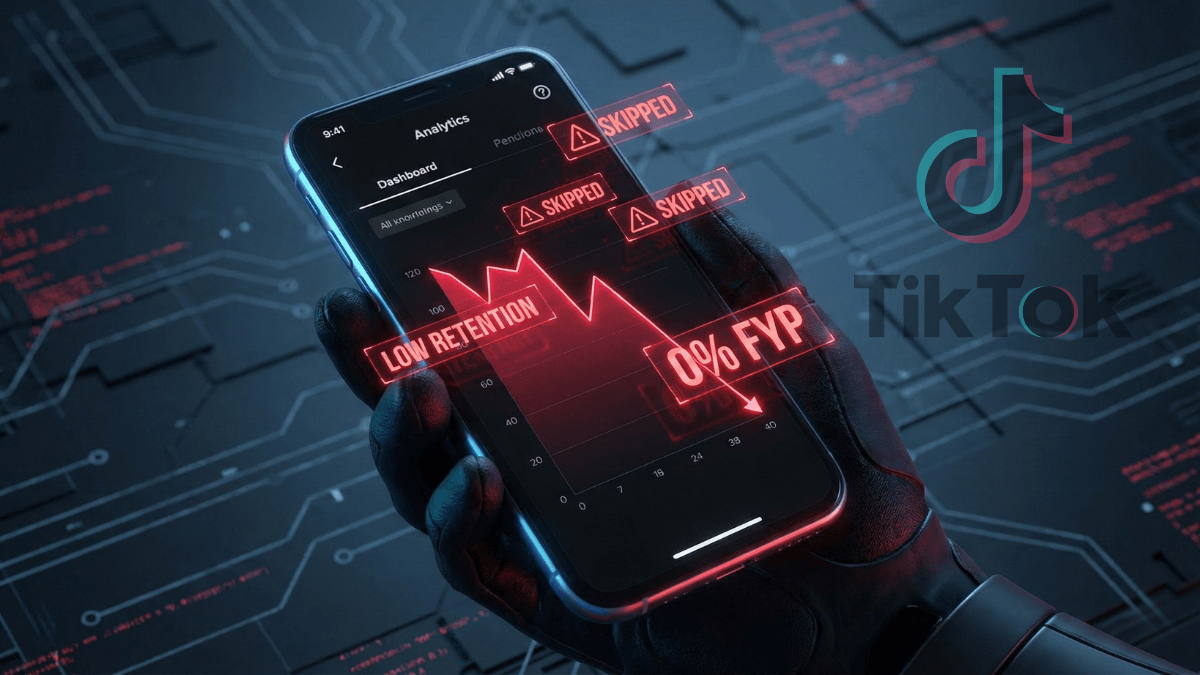
A video's success or failure isn't measured by view count alone — it's a combination of signals visible in TikTok Studio Analytics. A failed video shows three clear signs: For You share in Traffic Source near zero, a completion rate lower than your own past videos, and a sharp drop in the Audience Retention graph in the first few seconds. But note: a slow starter isn't necessarily a failure — there's a critical difference between "distribution stopped" and "distribution never started."
| What You See in Analytics | Diagnosis | What It Means |
|---|---|---|
| For You ≈ zero + very few views | Test batch failure | Video didn't clear the initial test phase |
| High For You + views rose then stopped | Stopped after first wave | Passed the test but second-wave signals weren't sufficient |
| Low For You + reasonable completion rate | Matching problem, not content problem | Video reached the wrong audience — caption/hashtag issue |
| Few views but For You still moving | Slow starter — not failed yet | Distribution is still active — don't intervene |
| Views only from Search or Profile | Algorithmic failure — limited organic success | Algorithm didn't distribute — but the video works in search |
Key Takeaways
- Low view count alone doesn't prove failure — the For You share in Traffic Source is the decisive metric.
- Don't judge a video before at least 48 hours have passed — some videos start slowly before taking off.
- Test batch failure is different from stopping after an expansion wave — each requires a different lesson.
- A failed video isn't deleted — it's analyzed to become the lesson for the next video.
- One video failing doesn't mean the account is failing — a repeated pattern is what affects the account's trajectory.
When Should You Judge a TikTok Video? The Right Timeframe
If you're a TikTok creator, one of the most common mistakes is judging a video after just a few hours. The right timeframe depends on what you're trying to evaluate — and TikTok doesn't officially disclose the precise timing of each distribution phase:
| Time After Publishing | What You Can Evaluate | What You Can't Evaluate Yet |
|---|---|---|
| First 3 hours | Initial For You share + whether distribution started | Whether spread will continue — subsequent waves haven't launched |
| 6 to 12 hours | Whether the first expansion wave launched | Final outcome — large-scale spread may still come |
| 24 to 48 hours | A clear picture of the video's overall performance | Late-bloomer spread — that possibility still exists |
| After 48 hours | Full diagnosis — did the video fail or stop naturally? | No restriction — but keep late-bloomer possibility in mind |
The practical rule: Wait 48 hours before making any final judgment. Per TikTok's official documentation, the system sends each video to an initial test batch and evaluates signals — and this evaluation can continue in successive waves across the first 48 hours.
What Are the Three Signs That Confirm a TikTok Video Failed?
To diagnose video failure accurately, look for these three signs together in TikTok Studio — not any one of them in isolation:
Sign 1: For You Share Near Zero in Traffic Source
Open TikTok Studio → Analytics → the video → Traffic Source. If the For You share is below 10% after 48 hours, the algorithm didn't meaningfully distribute the video to a new audience. Existing views come primarily from your followers or people who searched for your account directly.
This is the most important sign — because it tells you the algorithm decided not to expand distribution. For the complete guide on reading your Analytics dashboard, see our TikTok Analytics guide.
Sign 2: Completion Rate Below Your Own Baseline
Open Analytics → Video Performance. Compare the completion rate to your last 5 videos in the same niche at roughly the same length. If it's noticeably lower — the video didn't convince the test batch sufficiently.
Comparing against your own baseline is more meaningful than comparing against general numbers — because every niche and length category has different natural rates. See our article on what counts as a good retention rate on TikTok for detailed reference points.
Sign 3: Sharp Drop in the First 3 Seconds of the Audience Retention Graph
Open Analytics → Video Performance → Audience Retention. Is there a sharp decline in the first two or three seconds? This means viewers scrolled past before giving the video a chance — the hook didn't work in the test batch, sending negative signals that cut expansion before it could begin.
All Three Signs Together = Confirmed Diagnosis
For You near zero + low completion rate + sharp early drop — if all three are present, the video failed in the test batch and didn't trigger an expansion wave. Just one sign may mean something else — low For You with good completion, for instance, points to a matching problem rather than a content problem.
What Types of TikTok Video Failure Are There and How Do They Differ?
Not every "failure" is the same — and identifying the type determines the lesson you take from it. Per TikTok's official recommendation documentation, each video passes through independent evaluation stages — and failure at any one of them has a different cause:
Type 1 Failure: Test Batch Failure
Symptoms: For You near zero + low completion rate + sharp early drop.
Cause: The hook didn't work — viewers scrolled past in the first seconds before giving it a chance.
Lesson: Focus on the first two seconds in the next video.
Type 2 Failure: Stopped After First Wave
Symptoms: High For You initially + views rose then plateaued suddenly.
Cause: The hook worked, but the content didn't produce sufficient signals in the wider wave (completion + shares + saves).
Lesson: The hook wasn't the problem — the issue is pacing and value delivered after the opening seconds.
Type 3 Failure: Matching Problem
Symptoms: Low For You + reasonable completion rate + positive response from existing audience.
Cause: The algorithm sent the video to a mismatched audience — caption, hashtags, or sound didn't classify the video accurately.
Lesson: Review classification signals in the next video — caption, hashtags, sound choice.
Not a Failure: Normal Limited Performance
Symptoms: Moderate For You + acceptable views without wide spread + good completion rate.
Meaning: The video did its job, reached its audience, but didn't trigger wide-scale spread. This is normal performance for many videos from accounts in a building phase. It's not failure — it's cumulative fuel.
How Do You Tell the Difference Between a Failed TikTok and a Slow Starter?
This distinction is critical because the correct response to each is completely different:
| Indicator | Failed Video | Slow Starter |
|---|---|---|
| For You share after 24 hours | Near zero — hasn't moved | Still represents a meaningful share of views |
| Views-over-time graph | Completely flat from the start | Gradual or intermittent rise |
| Completion rate | Noticeably low | Reasonable or good |
| What to do | Open Audience Retention and analyze | Don't intervene — give it time |
A slow-starting video with For You still moving is a video in active distribution — just spreading more gradually than expected. Intervening (deleting it, posting a competing video immediately) stops what's already begun. See our guide on how long it takes for a TikTok video to go viral for the full distribution timing picture.
What Is the Difference Between Video Failure and Account Failure on TikTok?
This distinction prevents many creators from drawing the wrong conclusions:
Video failure: The signals from one specific video didn't convince the test batch. It happens to the best creators — even large accounts produce videos that fail. It's information, not a catastrophe.
Account failure: A repeated pattern of weak signals across multiple videos that gradually narrows the test batch — making For You Page (FYP) access harder with each new video.
How to Tell the Difference
- One or two videos with weak performance: Video failure — normal, analyze it and keep going.
- 5 or more consecutive videos with weak performance: Account-level issue — review your content strategy, niche, and hook approach.
- Sudden drop in performance from videos that were working: May be an account restriction — check Account Status in TikTok Studio via TikTok's Help Center.
If you're experiencing sustained decline across multiple videos, see our guide on why TikTok views drop suddenly.
How Do You Read Analytics After Confirming a Video Failed?
Once you've confirmed the video failed, the next step is extracting the lesson — which Analytics tells you if you read it in the right order. For the full Analytics reading guide, see our TikTok Analytics guide:
Analytics Reading Path After Failure
- Traffic Source first: For You near zero = algorithm didn't distribute. Moderate For You with low completion = content is the problem.
- Audience Retention second: Where exactly is the sharp drop?
- First 1–3 seconds → visual hook or opening line
- Between 5–15% of the video → hook's promise wasn't delivered immediately
- The middle → pacing or filler
- Near the end → good content but weak close
- Audience demographics third: Was the audience the video reached your intended target? If not — classification problem.
- Compare with your previous successful video: What was different about the video that worked? That's the variable to test in the next one.
What to Do After Confirming a Video Failed
The correct response to video failure isn't to delete it or stop posting — it's to analyze it and extract its specific lesson. All the data you need is available in TikTok Studio Analytics:
| Failure Type | The Lesson | What to Change in the Next Video | What Not to Do |
|---|---|---|---|
| Test batch failure (hook) | The first second didn't stop the scroll | Change only the first second — try a different visual or verbal hook | Don't change everything at once |
| Stopped after first wave (pacing) | Content lost momentum in the middle | Accelerate the pacing — cut the extra seconds where the graph dropped | Don't make the video longer |
| Matching problem | Caption or hashtags didn't classify the video accurately | Rewrite the caption to describe the content more precisely | Don't change your entire niche |
Don't Delete the Failed Video
A failed video retains its Analytics data — and that data is the evidence of why it failed and the specific lesson for the next video. Deleting removes the evidence and leaves you guessing. Use the "Only Me" privacy setting if you want to hide it — but don't delete the data. See our article on whether deleting a TikTok video hurts your account.
Change Only One Variable at a Time
If you change the hook, pacing, caption, and hashtags all at once in the next video and it succeeds — you won't know which one made the difference. Change one thing and observe the result. This experimental approach is what builds genuine understanding of your audience.
What Does This Change About How You Handle a Failed Video?
A failed video isn't a verdict — it's data. Three signals in TikTok Studio tell you exactly what happened and where the breakdown was. Creators who improve quickly are those who read failure this way — not those who avoid it or delete it. You can verify your Account Status in TikTok's Help Center to rule out any restrictions before diagnosing content issues.
Start by checking Traffic Source on your last failed video — is For You zero or moderate? That answer determines the entire path forward. For a deeper understanding of how the algorithm scores each signal, see our article on TikTok algorithm signal priorities. And for how the system tests your video before distributing it, see how TikTok tests your video before distribution.
What Do Creators Ask About Diagnosing TikTok Video Failure?
How many hours should I wait before judging my video's performance?
48 hours is the timeframe that allows a comprehensive evaluation in most cases. Some videos launch in the first hours, and some build between hours 12 and 36. Judging before 48 hours is possible — but risks writing off slow starters. After 48 hours, the video's trajectory is clear enough for a decision.
Can a failed video still go viral later?
Yes — if it receives a share from an account with a large audience, TikTok may retest it against a new group of viewers. This is the "late bloomer" phenomenon. This is specifically why you shouldn't delete failed videos — the late-bloomer possibility exists as long as the video is on the platform. See our guide on how long it takes for a TikTok video to go viral.
Does a low view count always mean a video failed?
No — few views with a high For You share and good completion rate means a video in distribution that hasn't peaked yet. Few views with a near-zero For You share means a video that failed the test batch. The absolute view number doesn't tell you why — Traffic Source and Audience Retention are what tell you.
Does reposting a failed video fix the problem?
No — reposting the same video without modification gives it a new test batch but with the same underlying problem. The result will be the same because the root cause hasn't been addressed. The right approach is to analyze the failure cause through Analytics, identify the one variable responsible, and apply the lesson in a new video.
Does one failed video affect future videos?
One failed video — to a very limited degree. A single video doesn't restrict the account. But a repeated pattern of weak signals across multiple videos gradually narrows the test batch and makes FYP access harder over time. This is an additional reason to analyze every failure and extract its lesson rather than ignoring it and moving on.