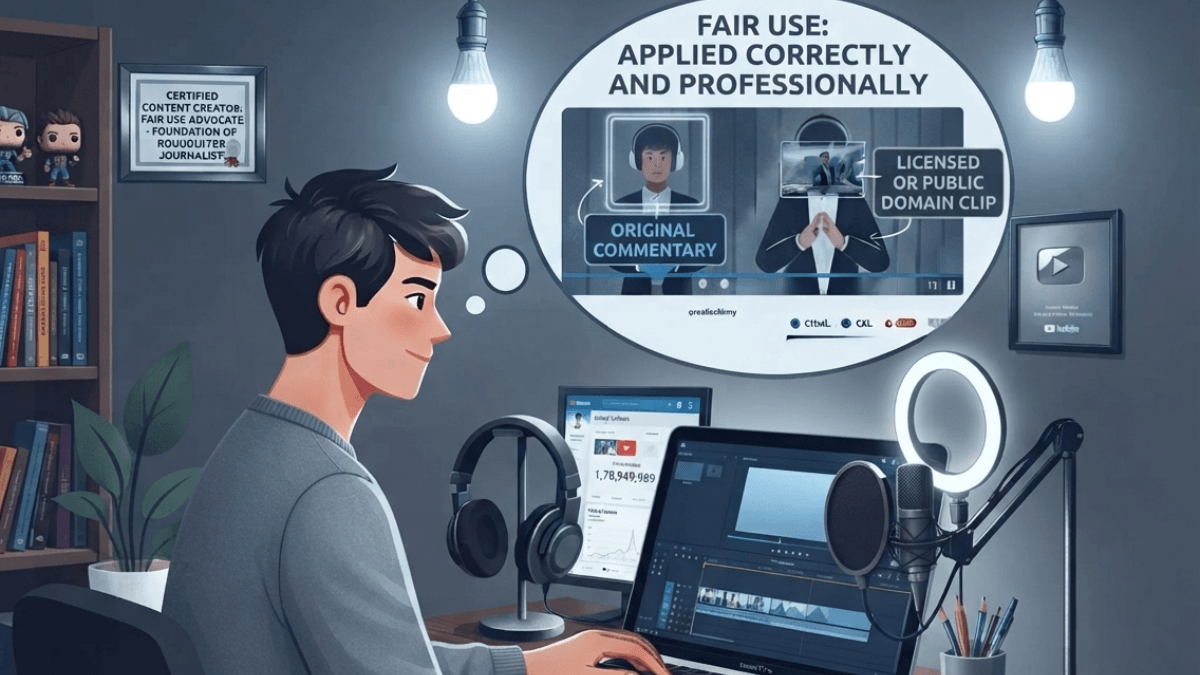
Fair use is a US legal doctrine that permits the use of copyright-protected content under specific circumstances without the owner's permission. There are no magic words that trigger it — not "no copyright intended," not "all rights to the owner." Per the official YouTube Help Center, only a court can determine fair use, on a case-by-case basis. Automated systems like Content ID cannot make that determination. Outside the US, different rules apply.
| Factor | Favors fair use when... | Weighs against fair use when... |
|---|---|---|
| 1. Purpose & character of use | Non-commercial, educational, commentary, criticism, transformative | Commercial, copies without adding new expression |
| 2. Nature of the copyrighted work | Primarily factual work | Purely creative/fictional work |
| 3. Amount & substantiality used | Small, non-central portion | Large portion, or small portion that is the "heart" of the work |
| 4. Effect on the market | Does not substitute for the original | Harms the rights holder's ability to profit from the original |
Key takeaways:
- Per YouTube's fair use page, judges evaluate all four factors together on the specific facts of each case — no single factor determines the outcome.
- Per YouTube's fair use FAQ, automated systems like Content ID cannot determine fair use — that decision belongs exclusively to courts.
- Per the official page, transformativeness is usually the key factor — adding new expression, meaning, or message to the original material is central to a fair use argument.
- Even a few seconds of copyrighted material can weigh against fair use if those seconds constitute the "heart of the work," per the official page.
- Fair use is US law. Outside the US, different frameworks apply — "fair dealing" in many countries, specific categories in the EU. YouTube considers local rules when reviewing removal requests.
The four fair use factors — how courts apply them
Per the official page, courts weigh all four factors together — no single factor decides the outcome in isolation.
Factor 1: Purpose and character of the use
Per the official page, non-profit educational uses are more likely to qualify as fair use than commercial uses. Adding new expression or meaning to the original material — what courts call "transformativeness" — is more likely to qualify than merely copying it. Transformativeness is usually the key factor in a fair use analysis. If your content does not add new expression, meaning, or message to the original, it is probably not fair use.
Factor 2: Nature of the copyrighted work
Per the official page, using material from primarily factual works is more likely to be fair use than using purely creative or fictional works. Films, music, and fiction are purely creative — making fair use arguments harder to sustain compared to news articles or documentary footage.
Factor 3: Amount and substantiality of the portion used
Per the official page, borrowing small portions is more likely to favor fair use than using large portions. However — and this is critical — even a small portion can weigh against fair use if it constitutes the "heart of the work." A few seconds of a song's most recognizable hook may be its heart, regardless of its brevity.
Factor 4: Effect on the potential market
Per the official page, uses that harm the copyright holder's ability to profit from their original work are less likely to be fair uses. Courts have sometimes made an exception under this factor for parodies — because parody by its nature targets the original work itself rather than substituting for it.
Five common fair use myths — officially debunked
Per official YouTube Help Center pages, none of the following protect you under fair use:
- ❌ Writing "No copyright intended" or "no infringement intended": Per the official page, there are no magic words to automatically apply fair use. This phrase does not protect you from a copyright infringement claim.
- ❌ Crediting the copyright owner or writing "all rights to the owner": Per the official page, giving credit to the rights holder does not grant you permission to use their content and does not turn a non-transformative copy into fair use.
- ❌ "I only used a few seconds": Per the official page, even a short use of popular songs can result in a Content ID claim. A few seconds that represent the heart of the work can weigh against fair use regardless of their length.
- ❌ "Similar content exists on YouTube already": Per the common copyright myths page, the existence of similar content does not mean you have the same rights. Rights holders sometimes permit some uses while restricting others.
- ❌ "My use is non-profit or educational": Per the official page, non-profit or educational purpose is one factor out of four — it does not automatically qualify a use as fair use.
Can YouTube or Content ID determine fair use?
Per the official page, automated systems like Content ID cannot decide fair use because it is a subjective, case-by-case decision that only courts can make. YouTube itself does not mediate copyright disputes and cannot determine whether your use qualifies as fair use. Only a court can make that determination.
What you can do on YouTube: if you believe your use qualifies as fair use, you can assert that position through the Content ID dispute process, which may continue through an appeal and DMCA counter notification if necessary. For step-by-step guidance, see the copyright claim removal guide.
Fair use outside the United States
Per the official page, fair use is a US legal doctrine. The rules differ significantly by jurisdiction:
- European Union: Use must fit specific categories — quotation, criticism, review, caricature, parody, and pastiche. The general "transformative" standard of US fair use does not directly translate.
- UK and Commonwealth countries: Apply "fair dealing," a related but narrower concept tied to specific permitted purposes.
- Other jurisdictions: Rules vary significantly. YouTube considers local rules when reviewing copyright removal requests.
Per the official page, it is the creator's responsibility to understand the applicable copyright law in their own jurisdiction before uploading content that uses third-party material.
What actually reduces your copyright exposure on YouTube
Per the official page, the simplest path is to avoid copyrighted material unless it is essential to the video. Documented alternatives:
- Use the YouTube Audio Library for music — available free of charge for use in videos per YouTube's documentation.
- If sourcing music from other royalty-free or licensing platforms, read the specific terms and conditions carefully before using — per the official page.
- If you plan to use copyright-protected material based on a fair use argument, per the official page: seek legal advice from an expert before uploading. YouTube cannot provide legal advice or make the determination for you.
Frequently asked questions
Is parody always protected under fair use?
Per the official page, courts have sometimes made exceptions for parody under the market effect factor — because parody targets the original work itself. However, parody is still evaluated under all four factors and is not automatically protected. Each case is decided on its specific facts.
Does recording a cover song qualify as fair use?
Per YouTube's official copyright FAQ, creating a cover song using someone else's creative content generally still requires permission from the copyright owner — even if you add your own performance. Fair use does not automatically cover cover songs because they reproduce rather than transform the original material. Separate licenses may be required for the sound recording, video synchronization, and lyrics.
Can I assert fair use through YouTube's dispute system?
Per the official page, you can defend your fair use position through the Content ID dispute process — and carry that through the appeal and DMCA counter notification steps if needed. However, YouTube does not adjudicate fair use and cannot rule in your favor as a court would. Asserting fair use through the dispute process means you are signaling your legal position, not receiving a legal determination from YouTube.
If I add my own commentary to someone else's video clip, is that fair use?
Per the official page, adding something to someone else's content does not automatically make it fair use. If the addition does not contribute new expression, meaning, or message to the original — it is probably not fair use. Courts will still consider all four factors, including how much of the original was used. Commentary and criticism are noted as common fair use examples, but each case is evaluated individually.
If I purchase a song or movie, can I use it in my YouTube videos?
Per YouTube's official copyright FAQ, purchasing content does not mean you own the rights to upload it to YouTube. Even if you give the copyright owner credit, posting videos that include content you purchased may still violate copyright law. Purchase grants a personal license to consume the content — not a license to redistribute or publish it.
Official sources
- YouTube Help — Fair use on YouTube: the four factors and geographic considerations
- YouTube Help — Fair use FAQ: why Content ID cannot determine fair use
- YouTube Help — Common copyright myths: what does not protect you from claims
- Google Legal Help — What is fair use?: the four factors from a legal perspective