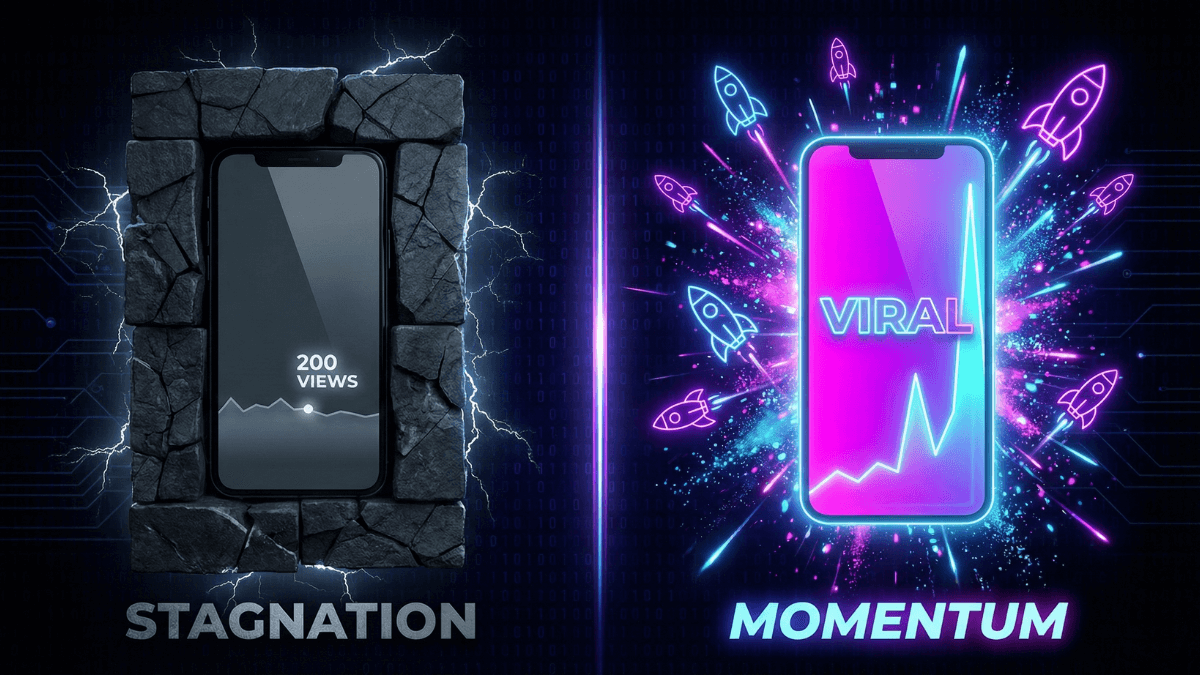
Your audience does not have a full minute to decide whether your video is worth watching. Videos go viral not because they are the best edited, but because they are the smartest at understanding the "attention economy." If you do not give the viewer an emotional reason or an unmissable benefit that stops their thumb in the first two seconds, they will move on — and the algorithm will consider your editing effort a waste of its server resources.
The effort trap: a video that failed after 14 hours of work
The harsh equation on TikTok: the algorithm does not reward hours of editing — it rewards how well the content fits the platform's fast-paced nature.
An educational video on "the history of AI development" took 14 full hours of filming, scriptwriting, cinematic editing, and visual effects. The result: it stopped at just 1,500 views.
The reason from analytics: the introduction ran for 6 seconds with the account logo before reaching the topic. Skip rate in the first 3 seconds: 82% of viewers. Total completion rate: just 1.8%. The impressive effort was buried because the hook was not fast enough for TikTok's impatient audience.
The surprise: a casual video that hit 1.8 million
The same creator, sitting in their car with phone lighting and zero editing, filmed 12 seconds saying spontaneously: "Quick tip — do not buy a laptop in 2026 before you check this one processor feature..." and demonstrated the steps directly on screen with their hand. The result: 1.8 million views in 48 hours.
What was different? The video stripped away all the "excess fat" and got to the point from the very first second. Completion rate in the test sample: 44% — and that number alone forced the algorithm to adopt the video and push it to the FYP.
The gap between the two videos: 14 hours of work = 1,500 views. 12 casual seconds = 1.8 million. The platform rewards directness, not polish.
The emotional trigger: the most powerful driver of spread
Videos that provoke strong emotions — shock, pride, anger, or laughter — push viewers to instinctively hit share or comment before they have even finished watching. The algorithm reads these emotions in comments and shares as evidence that the video "deserves discussion," and keeps it alive on the FYP for weeks.
A video reacting to a shockingly overpriced local product: 900,000 views + 45,000 shares + 12,000 comments. The share rate exceeded 5% of total viewers — the normal average is below 1%.
Anger and shock are not just reactions — they are the fuel of TikTok virality. Content that triggers "this can't be real" or "everyone needs to see this" is content the algorithm rides along with.
Shareable value: when the audience becomes a distribution agent
The most widely spreading content is content the viewer uses to express something about themselves or deliver free value to a friend. "Send this to your lazy friend who keeps saying they'll start the gym" — one sentence turns a viewer from a recipient into a distributor.
A video about "3 secret websites that save you on design subscriptions": 400,000 views + 32,000 shares + 51,000 saves. Combined shares and saves exceeded 20% of total views. The video spread not only because the algorithm pushed it — but because the audience became distribution agents, sending it in DMs and on WhatsApp.
The question to ask before every video you publish: "Why would someone send this to a friend?" If you do not have a clear answer, the video needs rethinking.
Trend timing: the fast train vs the late carriage
Riding a trend is a game of hours, not days.
A creator who rode a trending sound that exploded on the same day and produced a video within the first 6 hours of the trend appearing: 350,000 views easily — because the algorithm was in a "hunger" phase, actively seeking new content to feed the hashtag.
Another creator made the exact same video with the same trend and concept — but five days later, when the audience had started to tire of seeing it: 4,000 views only. The market was saturated and the algorithm had started suppressing videos that repeated the old trend.
The gap: 350,000 versus 4,000 — same content, five days apart. A trend is a train — catch it at the station and you ride it; miss it and it will not wait.
The shared genetic code of viral videos
After analysing over 50 videos that crossed the 500,000-view mark across different accounts and niches, one consistent pattern emerged across all of them:
Visual and text hook in the first two seconds → fast delivery pace with no dead pauses → an open ending that encourages replaying
This sequence is not a coincidence — it is a direct response to what the algorithm measures: a strong hook raises retention after 3 seconds, fast pacing raises completion rate, and an open ending raises the replay rate. Three positive signals in one video equals an immediate algorithm decision to expand distribution.
To understand how the algorithm evaluates these signals and makes its distribution decisions, read TikTok algorithm & going viral. And for the complete picture on the platform, read The complete TikTok guide.
Virality is not luck and not a secret — it is an equation that can be understood and applied. Start with the hook, then the pacing, then ask yourself: "Why would someone share this?"