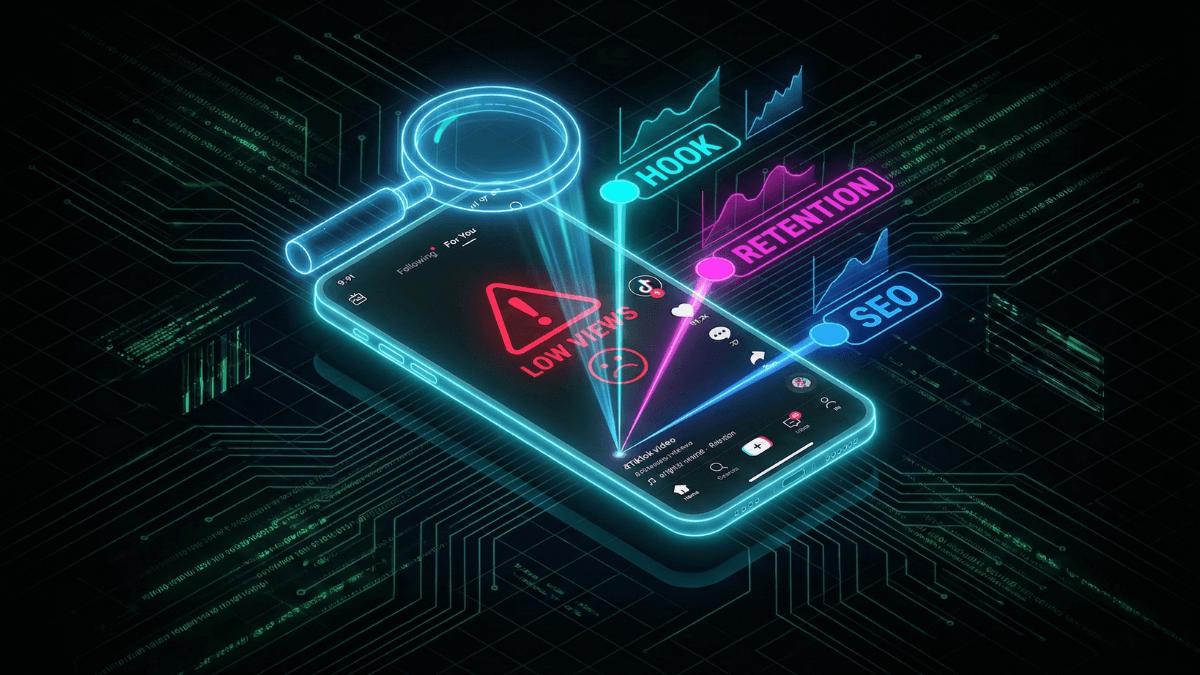
When views drop suddenly, most people react the same way: they change everything at once. New hashtags, delete the video, shift the posting time, sometimes switch the account type. Afterwards they still cannot say what actually made a difference, because five things changed on the same day.
The direct answer: low views are not one cause. They are an outcome at the end of a chain, and that chain starts with initial distribution, passes through how well the video holds a viewer, then through how well the topic matches an audience, and ends at account status and video eligibility. Each link in that chain has a different indicator inside your analytics, and a different action attached to it.
The job of this page is diagnosis: working out where the chain stopped before you start changing things. The practical work of raising views once you know the cause is a separate subject, and there are dedicated guides for it referenced in place.
One reference point before we continue: TikTok states plainly that "not all content is guaranteed to be recommended" in its For You feed standards. So an absence of distribution is not necessarily a penalty. It can simply mean the video did not clear the recommendation stage.
Do Low Views Mean Your Account Is Shadowbanned?
No, not automatically. This is the single most misread point.
TikTok separates three states that are not the same thing:
| State | What it officially means | How to check |
|---|---|---|
| Content ineligible for the For You feed | The video stays published but is not recommended in the feed | The eligibility notice on the video itself |
| Account restriction | TikTok states it may "restrict your account, which could include limiting your ability to post new content, appear in top search results, or in the FYF" | The Account check tool inside the app |
| Weak performance with no restriction at all | No violation and no notice. The video simply did not earn enough signal | Analytics, not notifications |
The third state is the most common one, and it is the one with no notice attached, which is exactly why so many creators assume a hidden penalty exists.
If your question is specifically about a hidden penalty and how to check for one step by step, the full detail is in TikTok shadowban. If the video is carrying an eligibility notice for the For You feed, that path is covered in why your video is not showing on the For You page. This page covers the wider case: low views in general, including all three states.
How Do You Tell Where the Problem Is?
This table is the core of the diagnosis. Read the numbers from your video analytics, then match them to the right column.
| What you are seeing | What it may mean | What to check first |
|---|---|---|
| Views stall at a very low number in the first hours | Distribution never widened past the initial sample | Completion rate and the first three seconds, then the eligibility notice |
| Views exist but average watch time is low | Viewers arrive and leave quickly | The hook, video length, clarity of the idea at the start |
| Good completion rate but reach never widened | The matching audience is narrow, or the sample is still small | Traffic source and audience distribution |
| Traffic source is mostly "Following" rather than For You | The video is only being shown to your existing audience | Topic match with an audience wider than your followers |
| Every video drops at once, including older ones | A stronger signal of a restriction or a change in account status | Account check, then your violation history |
| Only one video dropped | More likely a content or eligibility matter for that specific video | The eligibility notice on that video |
| The account is new or has few videos | There is not enough data to read a trend | Number of videos published, not account age |
The practical rule: do not change more than one variable before you read this table. Changing several at once hides the cause instead of revealing it.
The Main Reasons TikTok Views Are Low
The reasons below are ordered by where they sit in the chain, from distribution through to the account.
1. Distribution never widened past the first test
TikTok's recommendation system evaluates a video on signals, not on account size. TikTok states that recommendations rest on factors including user interactions (likes, shares, follows, comments), video information (captions, sounds, hashtags), and device and account settings (language preference, country setting, device type), and it notes that the last group carries lower weight because users do not actively express those as preferences.
What matters here: if enough interest signal does not materialise in that first exposure, distribution does not widen. That is not a penalty. It is the result of an evaluation.
2. Viewers arrive but leave early
TikTok describes a strong indicator of interest as "whether a user finishes watching a longer video from beginning to end", and contrasts it with a weak indicator such as the viewer and creator being in the same country.
Which means the difference between a video that widens and a video that stalls may sit in the opening seconds, not in the hashtags. How to read that metric is covered in what a good TikTok retention rate looks like, and the time-based metric itself in TikTok watch time.
3. The topic does not match a clear audience
The For You feed is an interest feed. If a video does not speak to a defined interest, the system has a harder time finding the right segment for it. And changing topic every few weeks restarts the process with a different audience each time, which looks like a sudden drop when it is really scattered targeting.
4. The content is reused or unoriginal
This one is written into the For You feed standards, not inferred. TikTok lists among content that is ineligible for the For You feed:
- "Reused or unoriginal content posted without creative edits, such as clips that show someone else's watermark or logo"
- "Low-quality or minimally edited content, such as short clips made from GIFs only"
TikTok also states that it does not recommend duplicated content, content the user has already seen, or anything considered spam.
So if your approach relies on reposting watermarked clips from another platform, that is an officially documented reason for non-recommendation, not a guess.
5. The video is ineligible or the account is restricted
Here a notice appears, and that is what separates this state from the ones above it. TikTok states that content temporarily under review by fact-checkers is likewise ineligible for the For You feed, and that it may restrict an account in cases of deceptive behaviour.
6. The sample is far too small to read a trend
One video proves no trend, upward or downward. TikTok's support page on unstable view counts points creators to the analytics dashboard to understand content performance, which means the reference is numbers across a period, not an impression after a single post.
7. Search discovery is weak
Part of your views come from in-app search rather than the For You feed. If your caption, sound and wording do not describe the video clearly, you lose that source. Check the traffic source in analytics before assuming the algorithm is the problem.
Weak Distribution vs Weak Retention
This distinction resolves most diagnoses, and it is still the one most often confused.
| Weak distribution | Weak retention | |
|---|---|---|
| What happened | The video was not shown to enough people | The video was shown but the viewer left |
| The indicator | A low view count from the outset | Acceptable views with low watch time |
| Where you read it | Total views and traffic source | Average watch time and completion rate |
| The right direction | Eligibility, topic match, clarity of idea | Opening, pacing, video length |
| The common mistake | Changing hashtags | Reposting the same video |
If the view count is low and average watch time is high, the problem is distribution, not content. If it is the other way round, content is the starting point.
When Is the Problem the Content Itself?
Indicators that point to content as the cause:
- Completion rate is low across most videos, not on one alone.
- The drop started after a change in style, topic or video length.
- The videos that perform better share a clear pattern, and the rest do not resemble them.
- The content depends on reposting without edits, which TikTok classifies as ineligible.
In that case, start at the opening seconds. The detail is in writing a TikTok hook, and the question of appropriate length in the best TikTok video length.
When Should You Check Account Status or Video Eligibility?
Move to this check if one of the following is true:
- The drop hit every video at once, including older ones that were performing well.
- A notice appeared on the video stating it is not eligible for the For You feed.
- You received a violation notice, or the account status changed in the Account check tool.
- The content falls into one of the categories set out in the For You feed standards.
An important note: the absence of a notice is not evidence of a silent penalty, and the absence of views is not evidence of a violation. The official tool for checking is Account check inside the app, and the full detail is in TikTok shadowban.
Is Posting Time the Reason?
Rarely the primary cause, and it usually takes the blame because it is the easiest variable to change.
TikTok does not publish an ideal universal schedule that works for every account, and it does not state that any given hour guarantees reach. What can be said with confidence:
- If watch time and completion rate are low, timing will not fix that. The problem came before distribution.
- If the indicators are good and distribution is limited, timing then carries enough weight to be worth testing.
- The only useful test is a test of your own account: comparing different times for the same type of content, across enough videos.
Put differently: timing is a secondary variable in diagnosis, and it is not tested until retention and eligibility have been ruled out.
What to Measure Inside TikTok Studio
TikTok points creators to the analytics dashboard when they notice view counts becoming unstable. These four indicators are enough for a diagnosis:
| Indicator | What it tells you |
|---|---|
| Total views over time | Whether the drop is sudden or gradual, and whether it is on one video or the account |
| Average watch time | Whether the viewer stays or leaves early |
| Percentage who finished the video | The strength of the signal the recommendation system reads |
| Traffic source | Whether reach comes from For You, from followers, or from search |
Read all four together. Any one of them alone gives an incomplete conclusion. How to read this dashboard in detail is in TikTok analytics.
A 5-Step Diagnostic Plan
Work through it in order, and do not skip a step.
- Establish the scope. Is the drop on one video or across the whole account? That alone halves the possibilities.
- Check eligibility and restrictions. Review the video notice and the Account check tool. If a notice exists, stop here and deal with it first.
- Read retention. Average watch time and completion rate. If both are low, the cause is in the content, not in distribution.
- Read traffic source. If most reach comes from followers rather than For You, the issue is topic match with a wider audience.
- Gather a sufficient sample. Compare a group of videos of similar type, not a single video, and change one variable per cycle.
By the end of step five you have one likely cause, not a list of possibilities.
What Not to Do When Your Views Drop
- Do not delete the video straight away. Deleting destroys the data you need for the diagnosis, and there is no official rule stating that deletion restores distribution.
- Do not change five things at once. You will lose the ability to tell which change mattered.
- Do not rely on undocumented "tricks". Reposting with different hashtags, switching account type, or posting filler clips to reactivate an account: none of that is officially documented.
- Do not assume a penalty with no notice. The official tool exists, so use it instead of guessing.
- Do not judge after one day. A trend is read across a group of videos and a period, not a single post.
- Do not treat weak distribution by buying numbers. Detail in the next section.
An expanded list of recurring mistakes is in common TikTok mistakes.
Where Do View Services Fit Into This Diagnosis?
The question comes up with every drop, so we answer it with clear limits rather than skipping it.
What the service is and what it is not: paid view services change the number displayed on the video according to the service selected. They do not control TikTok's recommendations, nor organic reach, nor retention rate, they do not guarantee engagement, and they do not resolve an account restriction or a video eligibility problem. That is a description of what the service does and does not do, nothing more.
Platform policy, sourced to TikTok itself: TikTok classifies what it considers inauthentic engagement as deceptive behaviour in its Community Guidelines, including the trade of services that artificially boost engagement, and states it may restrict an account or take other action when it detects this. That is the platform's policy as published, and it is subject to change by TikTok. Reviewing it and reviewing the current terms of use before using any service is the user's responsibility, and the decision is theirs.
The practical conclusion: if your diagnosis pointed to weak retention, ineligibility, or an account restriction, a view service resolves none of the three. Anyone telling you otherwise is promising something they do not control.
When Do You Move From Diagnosis to Improvement?
Move on once two conditions are met: you have identified one likely cause, and you have a sufficient sample supporting it.
After that the action becomes specific to what you found:
| Likely cause | Next step |
|---|---|
| Weak retention | Start at the opening seconds: TikTok hooks |
| Low watch time with unsuitable length | Best TikTok video length |
| Limited reach despite good indicators | How to reach the For You page |
| Not understanding the recommendation mechanism at all | The TikTok algorithm |
| Views are acceptable but followers are not growing | TikTok follower growth roadmap |
The rest of the TikTok guides are collected in the TikTok hub.
Frequently Asked Questions
Why aren't my TikTok videos getting views?
There are four common causes: distribution never widened past the first exposure, the viewer leaves early, the topic does not match a clear audience, or the video is not eligible for recommendation. Start by establishing whether the drop is on one video or across the whole account, because that alone rules out half the possibilities.
Why did my TikTok views suddenly drop?
A sudden drop across every video points more strongly to a restriction or a change in account status, and is checked through the Account check tool and your violation history. A drop on a single video is more likely a content or eligibility matter for that video specifically. TikTok does not publish a fixed duration for any drop.
Does my follower count cause low views?
TikTok states that follower count is not a direct factor in the recommendation system, and neither is the performance of your previous videos. A larger account may receive more views by virtue of its base, but the number itself is not an input to the decision.
Does deleting and reposting a video restore views?
There is no official rule from TikTok stating that. Deleting also destroys the performance data you need for the diagnosis. Reading the numbers first is the better move.
How long should I wait before judging a drop in views?
There is no official duration published by TikTok. The practical indicator is not time but sample size: a group of videos of similar type, not a single video.
Do new hashtags reset distribution?
Hashtags are one element of the "video information" that TikTok lists among its recommendation factors, but they are not a switch that resets distribution. If retention is weak, changing the hashtag will not address it.
Do paid views increase organic reach?
No. Paid view services change the number displayed according to the service selected, and they do not control TikTok's recommendations, organic reach, or retention rate, and they do not guarantee engagement. Complying with the platform's current policies and terms remains the user's responsibility.
The Bottom Line
- Low views are an outcome, and the cause sits in one of five links: distribution, retention, audience match, eligibility, sample size.
- Start by establishing scope: one video or the whole account.
- Check eligibility and restrictions before making any change to content.
- If watch time is low, the cause is in the content, not in distribution.
- Change one variable per cycle, and measure across a group of videos rather than one.
- View services do not resolve weak retention, restrictions, or ineligibility.
Official Sources
- TikTok Newsroom: How TikTok recommends content
- TikTok Community Guidelines: For You Feed eligibility standards
- TikTok Community Guidelines: Integrity and Authenticity
- TikTok Support: My posts aren't getting views
- TikTok Help Center: TikTok Studio