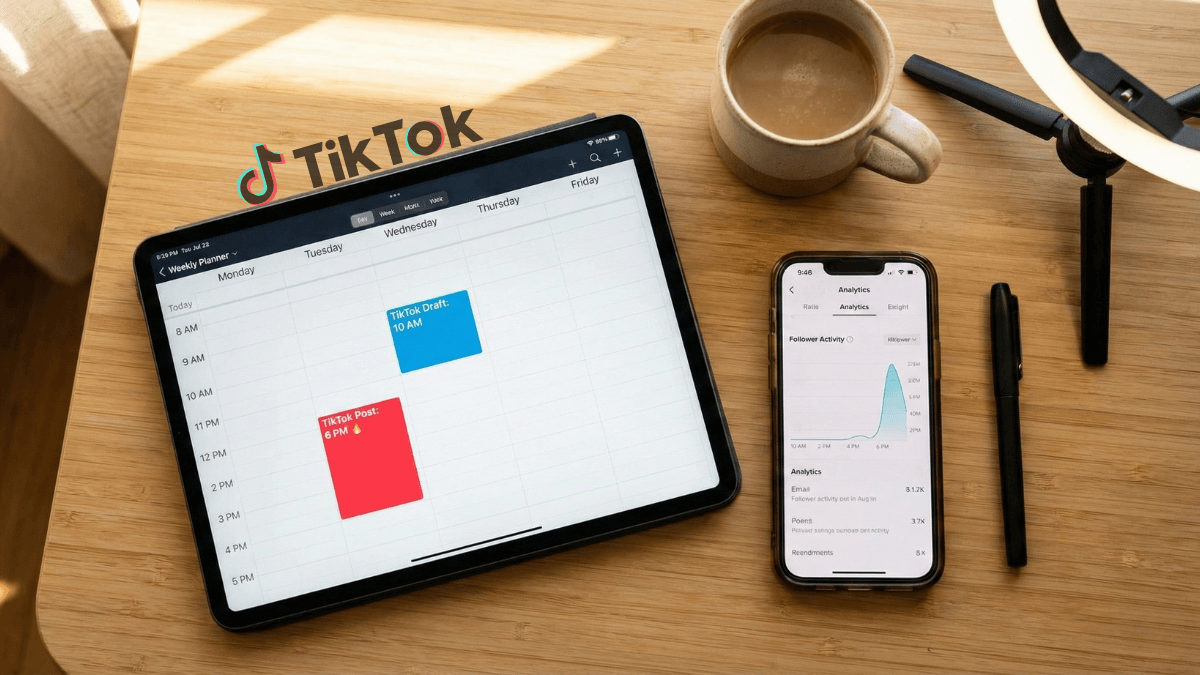
There is no single hour that works for every TikTok account, and TikTok doesn't publish one. TikTok's own documentation lists "the time the video was posted" as one of several signals its recommendation system uses, inside a non-exhaustive appendix with no weighting attached (TikTok Transparency Center). That's a narrower claim than "TikTok has a best time," and much of the confident-sounding advice on this topic comes from that gap.
Three vendors, Buffer, Sprout Social and Hootsuite, publish TikTok timing studies with a stated sample and method. Put their day-by-day tables side by side and no single hour appears in all three on any day of the week. The most reliable answer to "when should I post" sits in your own TikTok Studio data. Read it with one technical trap in mind: your follower activity chart runs on your local time zone, while the rest of your analytics runs on UTC.
This guide separates what TikTok documents from what vendors measure, and shows where the three studies agree and disagree. It also walks through reading your own numbers, with a specific look at what Riyadh time and the Gulf calendar mean for the exercise. For the rest of our TikTok coverage, see the TikTok hub.
Key Takeaways
Key Takeaways
- TikTok lists "the time the video was posted" as one of six video signals in a non-exhaustive list, with no weighting and no published best hour (Confirmed by TikTok).
- Buffer, Sprout Social and Hootsuite each publish a day-by-day table, and no single hour appears in all three on any day of the week (Vendor data, Tier 3).
- Buffer's single best slot of the week, Sunday at 9 a.m., falls on the day Sprout Social names as its worst day to post (Vendor data, Tier 3).
- Your own answer lives in TikTok Studio: the Viewers tab shows "Most active times" for the last 7 days, and the Followers tab breaks activity down by hour and day (Confirmed by TikTok).
- Follower activity displays in your local time zone while every other analytics figure displays in UTC, a documented gap that's easy to miss when building a schedule (Confirmed by TikTok).
- For a Riyadh-based audience, UTC+3 is the fixed reference point year-round; mapping vendor day-of-week findings onto the Saudi Friday-Saturday weekend is our inference, not a vendor finding.
Guide Contents
- What TikTok Documents About Posting Time
- What the Three Vendor Studies Found
- Why the Studies Disagree
- Starting Windows to Test
- Your Audience's Clock: Saudi Arabia and the Gulf
- The UTC Trap in TikTok Analytics
- Find Your Own Hours in TikTok Studio
- A Timing Test That Gives a Readable Answer
- How Often to Post on TikTok
- When Timing Matters Less Than the Content
- Common Posting-Time Mistakes
- FAQ
- Bottom Line
- About This Guide
1. What TikTok Documents About Posting Time
TikTok's transparency page describes its recommendation system in an appendix. The page itself calls the list "non-exhaustive": "This non-exhaustive list offers insight about the variety of signals and interactions the system utilizes to deliver personalized content to your FYF" (TikTok Transparency Center). Inside that list, TikTok names six video signals: "The time the video was posted," the region it was posted from, the author's language setting, the video's soundtrack, its length, and its hashtags (same source).
Posting time genuinely is a documented signal. It just isn't a documented lever, and those are different claims. TikTok publishes no weighting for any of the six items on the list, and the appendix frames them as examples inside a wider, unnamed set of signals. Don't read this as "posting time isn't among TikTok's published factors": it is, explicitly, one of them. What TikTok hasn't published is any statement about which time performs better, or by how much.
TikTok's 2020 Newsroom post groups its ranking inputs into three broader categories: user interactions, video information, and device and account settings (TikTok Newsroom, June 18, 2020). That post also states plainly that "neither follower count nor whether the account has had previous high-performing videos are direct factors in the recommendation system" (same source, 2020). It draws a distinction in signal strength too. A strong indicator, "such as whether a user finishes watching a longer video from beginning to end," would "receive greater weight" than a weak one. The weak example is "whether the video's viewer and creator are both in the same country" (same source, 2020). That strong-versus-weak example concerns interest signals, not posting time specifically, but it establishes that TikTok's own signals aren't weighted equally.
One more gap is worth naming directly: we found no TikTok statement describing how long a video keeps circulating after it's posted, no stated shelf life and no decay curve. Any "post at this hour to catch the wave" argument leans on a freshness window, and we found no TikTok description of one.
| What | Status |
|---|---|
| Posting time is one of several listed video signals | Confirmed by TikTok |
| A weighting or ranking among the six listed signals | Not found in TikTok's documentation |
| A recommended posting hour, day or schedule | Not found in TikTok's documentation |
| A stated shelf life or decay window for a video | Not found in TikTok's documentation |
| Follower count as a direct ranking factor | Confirmed by TikTok: not a direct factor |
| Posting time as the reason a video reaches more people | Our inference: plausible, but undocumented |
For the full breakdown of every signal TikTok has named and how they fit together, see how the TikTok algorithm works.
2. What the Three Vendor Studies Found
Three vendors publish TikTok-specific timing studies with a stated sample and method: Buffer, Sprout Social and Hootsuite. A fourth vendor, Later, also publishes a TikTok timing page, but it's dated March 2025 with no stated method, so it's excluded from the comparison below. All three studies here are labelled Vendor data (Tier 3): none of them is TikTok, and each measures its own dataset.
| Vendor | Published | Sample / window | Metric | Time-zone basis (verbatim) | Status |
|---|---|---|---|---|---|
| Buffer | Published Sep 14, 2026 | 7.1 million posts published through Buffer: videos, carousels, photos and text posts; window not stated | Median engagement rate | "no need to convert" after "mathematical magic" | Vendor data (Tier 3) |
| Sprout Social | Published March 31, 2026 | 2 billion engagements, Nov 27 2025 to Feb 27 2026; 307,000 profiles across 30,000 customers | Engagements | "All optimal posting times are listed in Local Time." | Vendor data (Tier 3) |
| Hootsuite | November 19, 2025 | Over 1 million social posts, 118 countries | Undefined on the page reviewed | "localized across 118 countries where sample data came from" | Vendor data (Tier 3) |
Buffer's page states: "we looked at the median engagement rate across 7.1 million posts published through Buffer" (Buffer, published Sep 14, 2026). Sprout Social states: "Sample size: 2 billion social media engagements between November 27, 2025 and February 27, 2026. Profiles analyzed: 307,000 global social media profiles across 30,000 Sprout Social customers" (Sprout Social). Hootsuite states: "Drawing on data from over 1 million social posts, we've pinpointed when audiences on TikTok are most active," localized "across 118 countries where sample data came from" (Hootsuite, November 19, 2025).
Buffer names Saturday as the strongest day: "The best day of the week to post on TikTok is Saturday." It adds: "Monday comes in second place, followed closely by Sunday" (same source). Its single best slot is Sunday at 9 a.m.: "the best time to post on TikTok is Sunday at 9 a.m., followed by Monday at 1 p.m., and Sunday at 1 p.m." Buffer itself calls that slot "a notable exception to the evening trend" (same source). Generally, Buffer reports that "engagement tends to pick up in the evening hours, with peak time slots between 6 p.m. and 11 p.m." By contrast, "Afternoons (12 p.m.-5 p.m.) tend to see lower engagement across most days" (same source).
Sprout Social's headline: "The overall best times to post on TikTok are Tuesdays through Thursdays between 2 p.m. and 6 p.m. Local Time." It calls Sunday "the worst day of the week to publish content on TikTok, reserved entirely for resetting," and adds that "Saturdays are an algorithmic dead zone" (same source). Hootsuite's headline: "The best time to post on TikTok for maximum engagement is Thursday morning (6 - 9 am) and Saturday midday (10 am - 6 pm)" (Hootsuite). Its industry note reads: "Morning posts tend to perform best for industries like hospitality, dining, and tourism. Afternoon and evening posts work better for media, entertainment, and marketing" (same source). Hootsuite's own per-industry detail contradicts that summary. Marketing agencies' best slot is "10 AM - 12 PM on Tuesdays," a morning window despite the "afternoon and evening" framing. Hospitality's own detail includes "4 - 8 PM on Thursdays," an evening window despite the "morning posts" framing.
Day-by-Day Recommendations
| Day | Buffer (best; runner-ups) | Sprout Social | Hootsuite | Shared hour, all three? |
|---|---|---|---|---|
| Monday | 1 p.m. (11 a.m., 8 a.m.) | 3-5 p.m. | 5 p.m. | No |
| Tuesday | 6 a.m. (10 p.m., 7 a.m.) | 2-6 p.m. | 10 a.m.-1 p.m. | No |
| Wednesday | 10 p.m. (6 a.m., 9 p.m.) | 1-8 p.m. | 4-6 p.m. | No |
| Thursday | 1 p.m. (10 p.m., 6 a.m.) | 1-5 p.m. | 7-9 a.m. | No |
| Friday | 6 p.m. (10 p.m., 8 p.m.) | 3-5 p.m. | 4-6 p.m. | No |
| Saturday | 5 p.m. (4 p.m., 3 p.m.) | Avoid posting | 10 a.m.-7 p.m. | No |
| Sunday | 9 a.m. (1 p.m., 12 p.m.) | Avoid posting | 8 a.m.-12 p.m. | No |
Sprout Social's Financial Services vertical is an exception in its own data: it lists "Weekdays and Saturdays" as best, with a Saturday slot at 6 p.m., and Sundays as worst. That doesn't change the wider picture. Adding it in still produces no hour shared by all three vendors on any day.
3. Why the Studies Disagree
Five structural differences explain most of the scatter in the tables above.
Populations. Buffer's sample is "posts published through Buffer," and Sprout's is 307,000 profiles across 30,000 of its own customers. Our inference: both draw on their own customers' data, which skews toward businesses and marketers who schedule content rather than creators posting live from the app. Hootsuite states "over 1 million social posts" across 118 countries but doesn't break out a TikTok-only sample size or describe its sampling frame further, so that inference doesn't extend to it.
Metrics. Buffer's stated metric is median engagement rate. Sprout Social reports "engagements" without a formula on the page reviewed. Hootsuite doesn't define its metric on the page reviewed. A different metric can rank the same hours differently, and none of the three lets you compare its numbers to the others' on equal terms.
Periods. Sprout's window runs 27 November 2025 to 27 February 2026, a stretch that includes the Northern Hemisphere holiday season in several of its likely primary markets. Our inference is that this is a poor window from which to generalize about weekend behaviour specifically. Buffer's page was published 14 September 2026 without a stated data window. Hootsuite's page, published 19 November 2025, labels its figures "2025 data" without a stated window either. One winter window and two unstated windows can't be compared like for like.
Time-zone basis. Sprout Social states plainly: "All optimal posting times are listed in Local Time." Hootsuite says the same, with a caveat: "the time of day was localized across 118 countries where sample data came from." Buffer's claim is different in kind: its "data science team has done some mathematical magic to make the recommended timezones universally applicable... no need to convert." That describes a result, not a method: Buffer doesn't explain how the conversion works.
Self-contradictions. Two of the three studies disagree with parts of themselves. Hootsuite's own day-by-day section lists Saturday as 10 a.m. to 7 p.m., an hour later than the "10 am - 6 pm" figure in its own summary line. It also lists Thursday as 7 to 9 a.m., against the summary's "6 - 9 am." Sprout Social calls Saturday "an algorithmic dead zone" globally, then lists Financial Services accounts' best days as "Weekdays and Saturdays," with a Saturday slot at 6 p.m. Adding that exception in doesn't change the three-way comparison: Buffer's 5 p.m., Hootsuite's 10 a.m.-7 p.m. and Sprout's 6 p.m. Saturday exception still share no single hour.
There's also a direct conflict worth naming on its own. Sprout Social's global windows put Tuesday through Thursday afternoons, 2 to 6 p.m., at the top of its table. Buffer's page states the opposite general pattern: "Afternoons (12 p.m.-5 p.m.) tend to see lower engagement across most days." Two studies, describing the same part of the day, reach opposite conclusions.
Buffer's own report includes a caveat worth reading. "It's worth noting that not all studies agree on this," Buffer writes. Other studies, it says, "have found stronger engagement on different days." That, in Buffer's words, "highlights how much results can vary by audience, dataset, and methodology." Buffer adds: "Use our findings as a starting point, then compare them with your own analytics." It concludes that "there's no single best time that'll work for every account on TikTok." That's the correct posture toward every table in this guide, including the starting windows below.
4. Starting Windows to Test
What follows is our editorial suggestion, drawn from where the three vendor studies above show at least partial overlap. It isn't a quote from any one vendor, and it isn't a TikTok rule. Treat it as a place to start testing, not a conclusion.
| Window | Time in your audience's local time | What the vendor data actually shows |
|---|---|---|
| Evening | 6-11 p.m. | Buffer's strongest general pattern, "peak time slots between 6 p.m. and 11 p.m." Touched only partially by Sprout (Wednesday's window runs to 8 p.m.) and Hootsuite (Wednesday and Friday 4-6 p.m., Saturday extends to 7 p.m.). Not a three-way agreement. |
| Afternoon | 1-5 p.m. | Genuinely contested: Sprout's global peak, 2-6 p.m. Tuesday through Thursday, versus Buffer's finding that afternoons "tend to see lower engagement." Worth testing, not assuming. |
| Morning | 6-10 a.m. | Buffer's best slots on Tuesday (6 a.m.) and Sunday (9 a.m.), plus its morning runner-ups on Monday (8 a.m.), Tuesday (7 a.m.), Wednesday (6 a.m.) and Thursday (6 a.m.); also Hootsuite's Thursday (7-9 a.m.) and Sunday (8 a.m.-12 p.m.) windows. |
Three caveats before you use it. These are windows to test, not hours proven to increase reach on their own. The clock that counts is your audience's, not necessarily your own, a distinction the next section covers in detail. If you already have data in TikTok Studio, skip this table and use your own numbers instead.
5. Your Audience's Clock: Saudi Arabia and the Gulf
Sprout Social and Hootsuite list their times in local time, and Buffer says its times need no conversion. Do not add a Riyadh offset on top of a vendor's number: doing so shifts a time the vendor already states in local time or says needs no conversion. Use the vendor tables as-is if your audience matches the population they describe, and use your own TikTok Studio data if it doesn't.
Riyadh runs on UTC+3 year-round: "The time zone is 3 hours ahead of UTC (UTC+03:00) with no daylight savings" (Wikipedia, Time in Saudi Arabia). Kuwait, Bahrain and Qatar share that offset, since Arabia Standard Time covers "Bahrain, Iraq, Jordan, Kuwait, Qatar, Saudi Arabia, Syria, Yemen" (Wikipedia, UTC+03:00). Jordan also sits at a fixed UTC+3, since it permanently abolished daylight saving time in October 2022 (Wikipedia, Time in Jordan; The National, 5 Oct 2022).
The UAE and Oman sit an hour ahead of Riyadh, at a fixed UTC+4 (Wikipedia, UTC+04:00). Egypt and Lebanon move relative to Riyadh during the year. Egypt observes daylight saving from the morning of 24 April 2026 until the last Thursday of October 2026 (29 October), under Law No. 24 of 2023. It matches Riyadh's offset in that window and falls an hour behind outside it (Egypt Independent, 27 Mar 2026). Lebanon observes daylight saving from the last Sunday in March to the last Sunday in October, with clocks changing at midnight. In 2026 that means 29 March until the start of 25 October, also matching Riyadh in that window (Wikipedia, Time in Lebanon).
Morocco is the largest and most changeable gap, and the one still moving as this guide is published. Through 19 September 2026 Morocco runs on UTC+1, two hours behind Riyadh. The IANA time zone database cites Decree No. 2.26.530. It records the planned return to UTC+0 without daylight saving from 20 September 2026. le360, reporting on 24 Aug 2026, states that clocks go back 60 minutes at 2 a.m. on 20 September 2026. From that date, Morocco sits three hours behind Riyadh.
| Place | Offset vs Riyadh (from 15 Sep 2026) | Basis |
|---|---|---|
| Kuwait, Bahrain, Qatar, Jordan | 0 | Same UTC+3 zone as Riyadh, no daylight saving |
| UAE, Oman | +1 hour | Fixed UTC+4 |
| Egypt | 0 until 29 Oct 2026, then -1 hour | Daylight saving until the last Thursday of October 2026 |
| Lebanon | 0 until 24 Oct 2026, then -1 hour from 25 Oct | Daylight saving until the last Sunday of October 2026 |
| Morocco | -2 hours until 19 Sep 2026, then -3 hours from 20 Sep 2026 | Returns to permanent UTC+0 on 20 Sep 2026 |
An offset described as constant "for most of the year" would be wrong here. Egypt, Lebanon and Morocco each change during 2026, and the changes land close together on the calendar.
Saudi and Abu Dhabi Weekends vs Vendor Weekends
Saudi Arabia's weekend has been Friday and Saturday since Royal Order No. O/185 took effect. The law firm's alert states: "Effective Saturday June 29, 2013, the new Friday / Saturday weekend will apply to all Saudi Arabian Ministries..." (Crowell & Moring, 24 Jun 2013). Abu Dhabi's government workweek moved to a Saturday-Sunday weekend with a Friday half day "as of 1 January 2022" (Abu Dhabi Media Office, 7 Dec 2021). That source covers the Abu Dhabi government specifically; we haven't verified whether it extends to the private sector across the wider UAE.
None of the three vendor studies states a Saudi-specific sample. Our search turned up no TikTok timing study with a stated sample covering Saudi Arabia, only lower-tier pages with no disclosed method. That's an absence, not a finding: it means the vendor day-of-week tables above describe whatever mixed population each vendor sampled, not a Gulf audience.
That leaves one useful, clearly labelled exercise: reading a vendor's Sunday finding against the Saudi week rather than a Monday-to-Friday one. Buffer's single best slot of the week is Sunday at 9 a.m., which happens to land on the first working morning in Riyadh, where Sunday follows the Friday-Saturday weekend. Sprout Social's "worst day" logic for Sunday describes a population where Sunday is the last day of a Saturday-Sunday weekend, the opposite position in the week for a Saudi audience. Neither vendor states this mapping. It's our inference, worth testing against your own data rather than treating as confirmed.
Ramadan and daily prayer times are a related gap. We found no TikTok statement, and no vendor study with a disclosed method, describing how posting activity shifts during Ramadan or around prayer times. If you manage a Gulf-facing account, our editorial suggestion is to re-read your TikTok Studio activity chart in the first week of Ramadan rather than carrying over a schedule built during the rest of the year.
Three practical cases cover most audiences:
- You and your audience are both in Saudi Arabia. Your own clock and your audience's clock match. Read your TikTok Studio data directly, and Riyadh time is your working reference for any vendor windows you choose to test.
- You post from outside the region, for a Saudi audience. Convert to Riyadh time first, then to your own clock. Posting in your own evening, if you're several hours behind Riyadh, can mean posting into your audience's early morning.
- Your audience spans several countries. Check your top locations in TikTok Studio before picking a single window. If one country clearly dominates, use its time zone as the reference. If the split is close, look for an overlap window and treat it as a hypothesis to test, not an assumption.
6. The UTC Trap in TikTok Analytics
TikTok's help centre documents three constraints on analytics that change how you should read your own dashboard. First, "Analytics are only generated for videos posted after you enable the feature" (TikTok Support). Second, "Analytics data may take 1 to 2 days to update" (same source). Third, and the easiest to miss: "Follower activity is displayed in your local time zone, while all other analytics data is displayed in UTC" (same source).
That third point means two parts of the same dashboard run on two different clocks. Follower activity, the chart you'd naturally use to pick a posting hour, uses your local time zone as the account holder, which isn't necessarily your audience's. Every other analytics figure you might check it against uses UTC.
For a Riyadh-based account, the gap is fixed and simple: UTC+3, year-round, with no daylight saving to complicate it. A creator elsewhere faces a gap that can also shift twice a year if their own location observes daylight saving.
Hypothetical example: your follower activity chart shows a peak at 8 p.m. local time. You then open a different analytics view that reports a spike at 5 p.m. Read side by side without adjusting for the offset, that looks like two separate signals. Correct for the 3-hour Riyadh-to-UTC gap and the two figures describe the same moment: 8 p.m. local time is 5 p.m. UTC. Build a schedule from the unadjusted comparison and you can target the wrong hour entirely, see no improvement, and reasonably conclude that timing doesn't matter, when the real problem is a clock mismatch. TikTok's support article on analytics covers the underlying constraints in full.
7. Find Your Own Hours in TikTok Studio
TikTok's own analytics are the only source that describes your specific account, not a sampled population. In the app, TikTok's Creator Academy gives this path: "go to your profile> tap the menu bars > select "TikTok Studio" > find "Analytics" and click "View all."" On the web version: "If you're accessing TikTok Studio via the web, just head to the "Analytics" tab on the left side of your screen" (TikTok Creator Academy, last updated Aug 18, 2026).
Two separate views cover timing, and they answer different questions. The Viewers tab shows "Most active times," which TikTok describes as letting you "learn when your viewers were most active on TikTok in the last 7 days" (same source). The Followers tab shows a separate view: you "can even explore your audience's consumption habits broken down by hours and days to help you understand when they're most active" (same source). Keep the two separate. One is a 7-day snapshot of viewers; the other is a habits view of your followers specifically.
You can widen the date range for the rest of your analytics. TikTok lets you "select your analytics date range for the last 7 days, last 28 days, last 60 days, last 365 days, or a custom report." On the web, custom reports reach back to July 17, 2022 (same source). Our editorial suggestion: use the 28-day range for overall trends and your top posts. "Most active times" stays a 7-day view, so read it across several weeks, since one week can be skewed by a single unusual video.
"Your top posts" is a section worth checking directly. It lists "Your 10 top-performing videos over the period of time you select, ranked according to views, likes, new viewers, and new followers gained" (same source). Open each one and note the hour it went out. A pattern repeating across ten of your own videos is a stronger signal than any vendor table (our editorial suggestion), provided you haven't always posted at the same hour.
One limitation applies here: TikTok states that some of the demographic breakdowns in analytics, including gender, age and location, are "based on predictive models rather than confirmed user data" (same source). Treat those specific figures as directional, not exact.
On very small accounts, the activity charts can look sparse or close to empty. That's an observation about small-sample charts generally, not something TikTok states about its own analytics; there simply isn't enough activity yet to plot a clear pattern. If that's your account, publishing consistently until the chart populates is more useful than trying to read a chart with too little data in it. Our complete TikTok Analytics guide walks through every tab, not just the timing views.
New Account or Established Account?
| New or low-follower account | Established account | |
|---|---|---|
| Data available | Follower activity view is often close to empty | Follower activity and Most active times are both usable |
| Where to start | The starting windows above, read against the Viewers tab rather than the Followers tab | Your own TikTok Studio data, with vendor tables only as a cross-check |
| Weight of timing | Lower: TikTok states that "neither follower count nor whether the account has had previous high-performing videos are direct factors in the recommendation system" (TikTok Newsroom, 2020) | Can matter more in practice, since part of early distribution likely runs through an existing follower base (our inference) |
| Real priority | Consistency and a clear topic | Tuning the window once content and cadence are stable |
The key point for a new account: TikTok states follower count isn't a direct ranking factor. A small account isn't held back by its size on that basis. Timing is simply a weaker lever there, because there isn't yet a follower base for it to act on (our inference).
Why "Best Time to Post Today" Has No General Answer
"Today" depends on three facts specific to you: where your audience is located, what day of the week it is in their calendar, and what your own 7-day "Most active times" view currently shows.
A workable substitute, our editorial suggestion: build a standing schedule from your tested windows, then recheck your follower activity periodically rather than asking the question fresh each morning. Re-reading the chart every few weeks catches real shifts in your audience without turning daily scheduling into a guessing game.
8. A Timing Test That Gives a Readable Answer
TikTok publishes no test protocol, no required number of videos, and no rule about how long to wait before reading a result. What follows is our editorial suggestion, built around the constraints TikTok does document, not a platform rule.
- Pick two windows, not three. Comparing two needs a third fewer videos than comparing three does, and a clean two-way comparison is easier to read.
- Hold format, length and topic constant. Comparing a tutorial in one window against a comedy clip in the other measures content type, not timing.
- Alternate between the two windows. Post one video in window A, the next in window B, and continue. A full week in one window followed by a week in the other lets whatever changed that week contaminate the result.
- Record results at 48 hours, not 24. TikTok's own documentation states that "analytics data may take 1 to 2 days to update" (TikTok Support), so reading at 24 hours risks comparing incomplete numbers. Record the view count, the percentage who watched the full video, and the traffic source at the same 48-hour mark for every video.
- Compare averages across each window, not single best videos. One strong video doesn't establish a window; the average across several does.
- Write your decision rule before you start. For example: "I'll adopt the window with the higher average 48-hour views, across at least eight videos per window." Deciding this in advance stops you from reinterpreting a mixed result afterward.
How Many Videos Before You Can Judge?
TikTok publishes no figure here, so treat the numbers below as our editorial suggestion, not a platform threshold.
- Fewer than six videos per window is generally too small a sample: normal variation between videos can easily be larger than a timing difference.
- Eight to ten videos per window is where a real difference starts to become readable, provided format and length stay constant.
- A gap that repeats across two full test cycles is the one worth acting on. A gap that only shows up once is more likely noise than a pattern.
At three posts a week split across two windows, a full cycle takes roughly five to seven weeks. Anything decided sooner is an impression, not a result.
Scheduling the Test
TikTok documents an official scheduling feature that makes a timing test easier to run consistently. Its Creator Academy states: "Use the schedule post feature. Head to TikTok Studio's web version to schedule your posts up to 30 days in advance and make sure you're reaching your viewers when they're most active" (TikTok Creator Academy, Aug 18, 2026). Scheduling matters for a test specifically because the video goes out at the hour you chose, rather than whenever you happen to be free to post it. Third-party scheduling tools are compared in our TikTok scheduling and automation guide.
9. How Often to Post on TikTok
TikTok's Creator Academy frames this question around consistency rather than a number. Its guide to building a posting routine states: "On TikTok, consistency matters more than perfection! Viewers are more likely to connect when you create authentic content and post frequently" (TikTok Creator Academy, Aug 18, 2026). That page describes no required number of posts per day or week.
The one specific figure that does exist comes from a different, older source. TikTok for Business's creative guide is dated 8 October 2021 and addressed to advertisers. In a section on always-on content, it says: "Aim to post 1-4 times per day to test how different types of content are received." The guide adds: "You can then add a paid boost to get the most out of your top-performing content" (TikTok for Business, 8 Oct 2021). Read the framing carefully: this is advertiser guidance about testing creative before backing a winner with a paid boost, not a claim about organic reach for creators.
You may also see this figure attributed to a "Creator Portal" recommendation. We couldn't trace that attribution to a current TikTok source; the sentence above, from the 2021 advertiser guide, is the one we could verify.
Frequency and timing are separate variables, so don't change your cadence and your posting window in the same cycle. Below is our editorial cadence table, built for planning purposes, not as a TikTok rule.
| Your situation | A starting cadence to test | Status |
|---|---|---|
| New or solo-run account, building the habit | 1 per day, or 4-5 per week | Editorial suggestion |
| Actively testing formats and windows | 2-3 per day | Editorial suggestion |
| Production-heavy content, filming plus long edits | 3-4 per week, held steady | Editorial suggestion |
Weekly planning around a chosen cadence is covered in building a TikTok content strategy.
Spacing Posts Within a Day
TikTok publishes no spacing rule between posts made on the same day. This is our editorial suggestion, made for measurement reasons rather than any documented penalty. If you post more than once a day, leave a few hours between posts. Spread them across different windows instead of stacking them close together. Two videos posted minutes apart in the same window make that window's result hard to attribute to either video individually, which undermines the test described above.
When Cadence Outruns Capacity
TikTok publishes no cadence ceiling. The check below is our editorial suggestion, not a platform rule.
Hold a chosen posting rate for a few weeks, then compare the per-video average before and after: 48-hour views and full-watch percentage. If the post count goes up while the per-video average goes down consistently, the cadence has likely outrun what your production can sustain. The fix is fewer, stronger posts rather than more. The video-count thresholds in how many videos before you can judge apply here just as they do to a timing test.
10. When Timing Matters Less Than the Content
No single hour makes a video go viral, and TikTok's own documentation gives no basis for it. Posting time is listed as one video signal among several, with no stated direction or weight (TikTok Transparency Center). TikTok's 2020 Newsroom post groups its inputs into user interactions, video information, and device and account settings. It gives one example of a strong signal: "whether a user finishes watching a longer video from beginning to end" (TikTok Newsroom, 2020). Completion is the kind of signal TikTok describes as receiving greater weight. Posting time isn't described that way anywhere we found.
Posting while your audience happens to be active can plausibly improve the odds of early engagement, since more of your existing followers see the video sooner. That's a reasonable mechanism, and it's still our inference rather than a TikTok statement. It doesn't push a video past viewers who stop watching it early, and it can't substitute for a video that fails to hold attention.
Does the best time change by content type? Possibly, but the evidence for it is thin and internally inconsistent. Hootsuite reports that "morning posts tend to perform best for industries like hospitality, dining, and tourism," while "afternoon and evening posts work better for media, entertainment, and marketing" (Hootsuite). As section 2 shows, Hootsuite's own per-industry detail contradicts that summary. Treat any industry-by-hour claim, including this one, as a hypothesis worth testing on your own account, not a rule.
If completion rate and watch time are the actual problem, changing the posting hour won't fix it, because the issue sits upstream of distribution. If retention looks healthy and reach is still limited, timing becomes a variable worth testing (our editorial suggestion). Our guides to a good TikTok retention rate and writing a TikTok hook cover that upstream problem directly, and TikTok content fundamentals and TikTok content ideas cover keeping a sustainable output once retention is solid.
11. Common Posting-Time Mistakes
- Copying a schedule with no time zone attached. A table without a stated reference zone can't be applied to your account at all.
- Using your own clock instead of your audience's, especially when posting from outside your audience's region.
- Adding a Riyadh offset on top of a vendor's number that's already stated in local time.
- Changing your test window every week, which leaves you with no comparable sample for any single window.
- Judging a window after one or two videos; normal variation between videos can easily be larger than a timing difference.
- Trusting a single reading of the 7-day "Most active times" view instead of checking it across several weeks.
- Changing posting time and content format in the same test cycle, which makes the result impossible to attribute.
- Assuming a Western Monday-to-Friday week applies to a Saudi or Gulf audience without checking it.
- Reading UTC-based analytics figures against your local-time follower activity chart without correcting for the offset between them.
- Believing a specific hour actively suppresses a video's reach. We found no TikTok statement to that effect; a slot you can't sustain also produces no readable sample, which looks similar but isn't the same thing.
- Tuning the posting hour before the opening seconds of the video hold attention.
FAQ
What is the best time to post on TikTok in 2026?
TikTok doesn't publish one. It lists posting time as a video signal with no stated weighting or preferred hour. Three vendor studies, Buffer, Sprout Social and Hootsuite, each publish a day-by-day table, and no single hour appears in all three on any day. The most reliable starting point is your own TikTok Studio data, read against windows like evening (6-11 p.m.), afternoon (1-5 p.m.) or morning (6-10 a.m.) in your audience's local time, as a hypothesis to test.
What is the best day to post on TikTok?
The three major vendor studies disagree. Buffer names Saturday as its strongest day, with Sunday 9 a.m. as its single best slot of the week. Sprout Social calls Saturday "an algorithmic dead zone" and Sunday its worst day. Hootsuite points to Thursday and Saturday. None of the three is TikTok data, and a disagreement this wide suggests the best day depends on your specific audience, not a general table.
Is there a worst time to post on TikTok?
TikTok publishes no worst time. The vendor studies contradict each other here too. Sprout Social names Sunday its worst day and calls Saturday "an algorithmic dead zone." Buffer ranks Saturday as its strongest day and Sunday 9 a.m. as its single best slot of the week. The most defensible answer is to look at the hours where your own follower activity chart is consistently flat, since that describes your account specifically rather than a mixed vendor sample.
Does posting at a certain time make a video go viral?
No single time does. TikTok lists posting time as one signal among several, with no stated weight or direction, while it describes finishing a longer video from beginning to end as a strong interest signal. Posting when your audience is active can plausibly improve early engagement, but it can't push a video past viewers who stop watching early, and it doesn't substitute for a video that holds attention.
How do I find my peak time on TikTok?
Open TikTok Studio, go to Analytics, then the Viewers tab for "Most active times," which TikTok describes as covering the last 7 days, so check it across several weeks. The Followers tab breaks activity down by hour and day. Set the analytics date range to 28 days for overall trends, and check "Your top posts" for when your best videos went out.
What is the best time to post on TikTok in Saudi Arabia?
We found no TikTok timing study with a stated sample covering Saudi Arabia specifically. Riyadh runs on a fixed UTC+3 with no daylight saving, so it's a stable reference point for your own TikTok Studio data. Mapping a global vendor's Sunday finding onto Saudi Arabia's Friday-Saturday weekend is a reasonable hypothesis to test, since Sunday is the first working day there, but it isn't something any vendor states directly.
Should I post 30 minutes before peak activity?
We found no TikTok or vendor source establishing this rule. It's a widely repeated tip with no documented basis we could trace. There's no real cost to testing it as one hypothesis inside a controlled comparison, alongside posting exactly at your active-times peak. Treat any result as specific to your account, not as a general rule to adopt.
Do posting times change during Ramadan?
We found no TikTok statement and no vendor study with a disclosed method describing how posting activity shifts during Ramadan. If you manage a Gulf-facing account, our editorial suggestion is to re-check your TikTok Studio follower activity chart in the first week of Ramadan rather than assuming your regular-season schedule still applies. Treat any specific claim about a Ramadan spike you see elsewhere as unverified unless it names its source.
How often should I post on TikTok?
TikTok's Creator Academy frames this as consistency rather than a fixed number, describing no required posts per day or week. The one official figure, 1 to 4 times per day, comes from a 2021 TikTok for Business guide addressed to advertisers testing creative before a paid boost, not organic guidance for creators. A cadence you can sustain for months is more useful than a high rate you abandon after a few weeks.
Is it better to schedule posts or publish manually?
TikTok offers an official scheduling feature through TikTok Studio's web version, allowing posts up to 30 days in advance. Scheduling helps most when you're running a timing test, because the video goes out at the hour you chose rather than whenever you happen to be free. Outside a formal test, either approach works as long as you can hold the schedule consistently.
Bottom Line
TikTok documents posting time as one signal among several, with no published weighting and no recommended hour. Three vendor studies contradict each other on the best day and the best window, which is itself a reason to treat any single table as a hypothesis rather than an answer.
- TikTok lists posting time as a signal; it publishes no best hour, day or schedule.
- Buffer, Sprout Social and Hootsuite share no single best hour on any day of the week.
- Your own TikTok Studio data, read past the UTC-versus-local-time gap, is the most audience-specific answer available.
- For a Riyadh-based audience, UTC+3 is the fixed reference point; mapping vendor findings onto the Saudi week is an inference to test, not a fact.
- A controlled test (two windows, fixed format, results read at 48 hours) gives a more reliable answer than any general table.
- If completion rate is weak, fix that first: timing can multiply a video people already want to watch, but it can't rescue one they don't (our inference).
For the rest of our platform coverage, see the TikTok hub. The same disagreement between vendor studies shows up on other platforms too: our Instagram posting-time guide and YouTube posting-time guide work through it for each.
About This Guide
This guide is maintained by the D3M Follow editorial team. Platform claims come from TikTok's Transparency Center, the TikTok Newsroom, TikTok Support, TikTok Creator Academy and TikTok for Business. Vendor studies from Buffer, Sprout Social and Hootsuite are labelled Vendor data (Tier 3), not TikTok data. Time-zone and weekend facts come from Wikipedia's UTC offset pages, a Crowell & Moring client alert, the Abu Dhabi Media Office, Egypt Independent, The National, le360 and the IANA time zone database.
Claims labelled "Confirmed by TikTok" quote or closely paraphrase TikTok's own documentation. "Vendor data (Tier 3)" describes a third-party study, not a TikTok statement. "Our inference" marks a reasonable reading of the evidence that TikTok or a vendor doesn't state directly. "Our editorial suggestion" marks a recommendation with no official source at all, offered as a starting point for your own test.
First published 14 December 2024. Rewritten and last reviewed 15 September 2026. Next check due when a vendor study updates its figures, after Morocco's clock change on 20 September 2026, or after Egypt's and Lebanon's clock changes in late October 2026.